Showing posts with label Long Term Electricity Plan (LTEP). Show all posts

Sunday, April 30, 2023

87 years of electricity demand history ought to be relevant for planning


I’ve assembled a long view of annual Ontario Electricity production and/or consumption, from 1935 to 2022. There should be policy implications to take from the data.

Over 12 years ago I published the first article on my first blog: “The Current and Future State of Electricity, as the [Ontario Clean Energy Benefit (OCEB)] comes to Ontario.” I noted in that work that 2010, “[Seemed] like a good time for a big picture overview…” The OCEB was a 10% reduction of bills to, “help consumers manage rising electricity prices for the next five years.” Twelve and half years later the discount has a different name (Ontario Energy Rebate), and is 11.7%. 2023 strikes me a lot like the period running up to the Green Energy Act, so here’s the long view of Ontario’s demand history as information to protect for a repeat of that heist as we renew interest in procuring new sources to meet future provincial demand..

The graph of demand for the last 88 years contains 4 data sources, none of which are matched precisely to another:
  • “Porter” refers to the chair of 1980’s “The Report of the Royal Commission on Electric Power Planning”, and specifically data contained in appendix A of Volume 2. The figures shown are cited as originating in “Ontario Hydro’s Power Resources Report No. 790201.” In terms of comparison to other data sources in the graph the notable thing about this is that the figures represent production (not demand), and they’re a partial representation of production as there was electricity generated by entities other than Ontario Hydro.
  • CANSIM 127-001 is a Statistics Canada monthly dataset built from survey data that existed, at a couple of levels of complexity, from 1957-2007. For purposes of attempting alignment with other data sets, I’ve subtracted from the report’s “Total Available” value the figure shown for “Total Industrial Generation.” Without diving into the exact meaning of the latter field I assume it is self-generated (or behind-the-fence) generation which, while nice to know, is not a component of the other data sets in the chart. It must also be noted “Total Available” includes imports and excludes exports, unlike the “Porter” data
  • “IESO Demand” is the figure reported by the Independent Electricity System Operator (IESO) as “Ontario Demand” - by which I understand they mean demand for supply from the IESO-controlled Grid (ICG). This differs from CANSIM 127-001 in a couple of ways: it will not capture generation from generators embedded within local distribution companies’ grids but it is data based on data far more reliable that that collected through surveying
  • “IESO Consumption”is a figure from the calculation of global adjustment charges as that proportional chargeback tool (for costs of supply not recovered through market revenue) requires calculating a consumers usage as a share of all consumers’ usage. As confusing as that sounds, this measure essentially differs from Ontario Demand in that it does capture the impact of distributed generators in supplying demand, although it omits the share of generation that is lost in transmission lines (as does the CANSIM 127-001).
The initial graphic is minorly distorted as Porter misses some generation, the survey data is inherently more prone to error, and at the latter years show the growth of distributed generation as the IESO’s “Demand” diverges from its “Consumption”.

Sunday, February 9, 2020

An outlook against lower electricity costs

Can anything be done to reduce the costs of electricity in Ontario?

I get the question more frequently lately.The answer is “yes". Something, theoretically, could be done. 

In reviewing 2019’s electricity figures I estimated the average cost of procuring one megawatt-hour (MWh) of supply was $94, and showed how that became $126/MWh for most Ontario consumers. That is an indication there’s plenty of room to find savings, so much room that there’s a more important question than how to reduce costs.

It's also possible to prevent costs from falling. Having written on excess supply, cost shifting away from unimportant consumers to influential "stakeholders", high contract costs, and may other issues for nearly a decade, I'm not inspired to address the question of what could be done - the more interesting question I will address is, "What is being done to prevent costs from falling? 

The current government was elected on a platform that included the claim they’d, “Cut hydro rates by 12% for families, farmers, and small businesses.” Over their first year and a half in office there’s been little to inspire confidence they’re capable of delivering on that promise. A recently released provincial finance report noted the cost of electricity programs ballooning another $1.5 billion as they head towards $5.6 billion for 2019-20 (ending March 31). The hit on the provincial treasury is largely due to subsidies preventing consumers on regulated price plans (RPP) from seeing rates increase on their electricity bills.

The 12% cut in the Progressive Conservative’s platform was in addition to the [un]Fair Hydro Plan (FHP) of the previous Liberal government - which promised (and did) reduce bills 25% in the present by deferring costs to the future. I developed a great contempt for that plan, but I could also view it as an unpleasant distraction. The Liberal government did deliver a long term energy plan (LTEP) that promised cost controls through improving what is whimsically referred to as Ontario’s electricity market.
Market Renewal will ensure the province has appropriate sources of electricity at the lowest possible price. This initiative could save Ontarians up to $5.2 billion over a 10-year period. -Glenn Thibeault, Minister’s message introducing 2017 Long-Term Energy Plan, October 2017
The plan - the long-term energy plan - was to improve the market for consumers.

Then, the nominally Independent Electricity System Operator (IESO) consulted stakeholders/insiders. In 2 short years they’ve reduced potential savings to consumers - which might be considered costs to the IESO’s stakeholders/insiders- by over 80%.
The Market Renewal Program is an important piece of the equation for us. With the approval of the high-level designs of the energy work stream, and a business case that estimates we can achieve $800 million in net benefits over the first 10 years alone, we’ve built a very strong foundation for change. - Peter Gregg, IESO President and CEO, November 2019
A $4.4 billion drop in the promised decadal value of market renewal, in under 2 years, is only one way the IESO is maneuvering to prevent a reduction in spending on electricity supply in Ontario. Others include inflating demand forecasts, lowering performance expectations from existing generators, raising capacity reserve desires, and exaggerating the threat of rising emissions.

Thursday, January 30, 2020

Ontario electricity demands - an appendix.

Last week Ontario's Independent Electricity System Operator (IESO) released its first Annual Planning Outlook (APO), which is pertinent to the next article I wanted to write. This isn't that article - it's an explanation of graphics I created for the article I want to write.


While the APO the first of the new thing, it's just the latest in a line of forecasts intended to guide electricity planning in the province. This graphic shows 5 previous forecasts, but I felt I should explain their origins, and note they may not be strictly comparable. "Demand" is, in Ontario, a word that is, by itself, not very definitive.

Monday, March 13, 2017

Not another Long-Term Energy Plan

The Minister of Energy will produce a Long-Term Energy Plan (LTEP) in the not too distant future. I've offered commentary during the planning period of two earlier LTEPs, in 2011 and 2014, but my advice this time didn't require complying with any official input period because it would be officially rejected anyway.

My advice on preparing 2017's Long-Term Energy Plan is simply this: don't.

I've been asked for thoughts on the new LTEP a couple of times, so I'll present some here primarily for the frequent readers of my work, including some authentic public servants, and hopefully also for a Minister of Energy - although probably not today's.

The primary reason for individuals to avoid the LTEP process is it's been a gimmick - a tool to present Ontario Liberal Party (OLP) policy to the electorate as if it was professionally and independently developed. The connection of professionally developed policy and elections began in 2007. The OLP had come to power in 2003 aided by displeasure over the handling of the electricity file by the previous Progressive Conservative (PC) government. It worked quickly in redesigning the sector to include a professional planning body, the Ontario Power Authority (OPA), which was tasked with producing an Integrated Power System Plan (IPSP):
  1. The initial IPSP was submitted to the Ontario Energy Board for consideration in August 2007, just in time for the OLP to campaign on the document for the October 2007 election,
  2. the first LTEP was put out early in 2011 to be the basis for an IPSP, and the OPA did have a draft IPSP on the minister's desk prior to the election in October 2011, although the OLP never did let that draft into public view,
  3. the next LTEP came out late in 2013, and served as the basis for OLP electioneering on energy in the election that followed in June 2014.
Participating in the development of an LTEP is participation in developing an OLP election platform.

The occupant of the office of the Minister of Energy is currently Glen Thibeault, signalling this LTEP will be as politicized as ever. Last May a report indicated then Minister of Energy Bob Chiarelli, "at loggerheads" with "Environment Minister Glen Murray ...over the possible effect [of carbon costs due to the Climate Action Plan] on electricity prices." At the time Glenn Thibeault was Murray's Parliamentary Assistant, so the introduction of Thibeault as Minister of Energy, in June 2016, was confirmation Chiarelli's concern for electricity pricing had lost the battle. During his first 6 weeks as Minister of Energy Thibeault directed the construction of a $1.4 billion hydro line to service 10,000 distant consumers and refused to recognize electricity pricing as a crisis.

Eight months later, Thibeault sat with the Premier at a press conference due to a crisis. It's unclear if the crisis was electricity pricing or their party's polling numbers, but the actions taken to resolve the crisis don't address the fundamental factors that drove prices higher - so it's probably the polling.

Ontario's next Long-Term Energy Plan is to be produced by a rookie minister three-quarters of the way through his first year in the office, during which he's moved from not seeing a problem with costs to burdening a future generation in order to offer 25% off electricity pricing to 2018's voters.

Tuesday, February 14, 2017

The failure of the global adjustment: a renewables story

I recently was asked about the cost of buying out one group of Ontario solar contracts. The microFIT (feed-in tariff) contract exposure I estimated at $3.9 billion. This is the eventual cost of all your neighbours' panels, but not the larger arrays, which I estimate will cost another $33.9 billion. Call it a $38 billion liability which matches the most famous liability in Ontario's electricity sector history: the $38 billion attributed to Ontario Hydro at dissolution in 1998 - liabilities attained in building almost all of the province's generation, its transmission infrastructure, and much of its distribution infrastructure.

The solar contracts that carry the $38 billion total will produce about 4.3 terawatt-hours (TWh) of electricity a year, which is roughly 3 percent of Ontario's demand.

This solar story is about the failure of the global adjustment mechanism.

Wednesday, December 21, 2016

Historical ignorance: on energy losses in decadent Ontario


Accusations of losses on electricity exports, and government denial of the fact, is far from news, but the reappearance of the topic in Ontario's legislature demands it be reviewed anew.
Progressive Conservative Leader Patrick Brown says the province sold $9.4 million worth of excess electricity for just $144,000 on Nov. 10...
Brown says Ontario has "given away" $6 billion in surplus electricity since 2009 by selling it at a big loss...
Energy Minister Glenn Thibeault...says Ontario made $230 million in 2015 by selling excess electricity to neighbouring jurisdictions.
Thibeault says Ontario suffered through power shortages and brown outs when the Conservatives were last in power, and had to spend up to $500 million a year to buy electricity from its neighbours to keep the lights on.
   -the Canadian Press via ctvnews.ca
I wrote on the costs to Ontario ratepayers of cheap exports almost 6 years ago, in rebutting the same spin as the Minister delivered yesterday when presented by a previous Premier. Later, in 2013's Ways to estimate Ontario's losses on electricity exports I demonstrated multiple methods to quantify losses on exports. The estimates of losses vary by methodology and assumptions, but if methods are applied consistently all indicate increased costs to Ontario consumers from producing far more electricity than necessary to meet their demands .

I won't revisit all the arguments I've made in the past, but instead tailor a response to the rookie Minister's old denials, emphasizing how poorly he is prepared to undertake the task of developing a plan for the sector.

Wednesday, November 30, 2016

Ontario Energy Minister Previews Long-Term Energy Plan Themes

"I've really come to respect the enormous complexity of the energy and electricity system in Ontario."

Ontario's rookie Minister of Energy, Glenn Thibeault, is now confident enough of his grasp of the province's energy system that he unveiled themes for an upcoming Long-Term Energy Plan in a speech to the Empire Club:
  1. Nature and style of procurement should be technology agnostic
  2. Ontario's electricity market renewal/reform to provide better value
  3. Empowerment of consumers
These are ambitious themes. Unfortunately Minister Thibeault didn't display an understanding of the institutional barriers to change, and he's going to need to confront the demons of the sector before meaningfully advancing any of these goals.

He seems to expect the barriers to deliver change.

Monday, September 12, 2016

Communication, Politics, Money: Wynne's electricity/electoral strategy

The Premier of Ontario launched a campaign advertising her concern about the impact of high electricity rates in proroguing the legislature, which allowed for a New Speech from the Throne setting government priorities. The speech announced a new policy for residential electricity consumers, re-implementing an old policy but providing an excuse to discuss the communication strategies impacting the electricity narrative in Ontario - among the political parties, and allegedly public servants.

A brief reverse timeline on tax policies and electricity in Ontario:
  • September 12, 2016 the Wynne government announces the provincial portion of the Harmonized Sales Tax (HST) will be rebated on residential and small business consumer bills as of January 1, 2017;
  • January 1, 2015 the Wynne government removes the Ontario Clean Energy Benefit (OCEB) that deducted 10% of residential electricity bills
  • January 1, 2011 the McGuinty government (same party) introduced the OCEB
  • July 1, 2010 the McGuinty government adds 8% to residential electricity bills when the Provincial and Federal sales taxes are harmonized as the HST
Let's not pretend that today's announcement is creative or terribly meaningful, but uncover the limitations that prevent the Premier from doing something meaningful to control costs - or allow her to let rates rise higher.

David Herle is an influential political strategist notable for co-chairing the Premier's successful 2014 election campaign. In February (2016) Mr. Hearle delivered a presentation to the Canadian Nuclear Association (CNA). The first point Mr. Hearle had on his slides was:
Rates are an increasingly major concern in Ontario. The cost of electricity is not just seen to be unreasonably high, it is widely seen as damaging to the provincial economy. 
  • Slowing rate increases is critical. 
  • Electricity is a necessity not a luxury.
A conservative strategist, Nick Kouvalis delivered a similar presentation to the Ontario Energy Association in the fall of 2015. That presentation also showed survey results indicating economy and jobs topped concerns, with energy prices not far behind.

Mr. Hearle noted some characteristics of public opinion that now drive Ontario Liberal Party public speaking on electricity. People like:
  • the elimination of coal
  • improved reliability
  • conservation
  • renewable energy (many remain positive on industrial wind - and most on solar)
Hearle, it seems to me, indicates a communication strategy that recognizes people don't want to blame cost hikes on things they like, and therefore Liberal policy is to challenge people to associate increased rates to the achievement of outcomes they desired - specifically coal's elimination in the generation of electricity, and alleged improvement to system reliability.1

Thursday, June 23, 2016

The declining capacity value of solar in Ontario, and beyond

A solar panel added to Ontario, today, has a capacity value of less than 6% and the reality is if solar continues to be added peak requirement for new supply will move to winter evenings and instead of new solar’s capacity value being close to nothing it will be absolutely zero.
I wrote that yesterday and, inspired by an exchange on Facebook, want to support the statement, add industrial wind to it, and argue the relevance of the statement not only to Ontario, but in California where the claim is a nuclear power plant can be closed and the output replaced with negawatts/efficiency/conservation, solar and wind.

Electricity supply is of value to a system in multiple ways. The two I examine are basically the actual watt-hours of output (I'll call this "energy value", and the ability to produce the output when demand calls for it (this I will call the "capacity value"). 

The diminishing value energy value of intermittent generation should not be well known. I was excited to write on the decrease three years ago, but a current work from Lion Hirth (and Simon Müller) explains well why now seems obvious:
In hours of high wind speeds, the additional supply of electricity from wind turbines depresses the price below the level it would otherwise have been. This price drop is greater, of course, when larger amounts of wind power are installed, a phenomenon that has been described as the “self cannibalization effect” (a dramatic term for the simple consequence of increased supply). As a consequence, the market value of wind power declines with its market share.
This post will deal only with "capacity value".

Additional solar, and wind supply, have lower capacity value today because the operator of Ontario's electricity system, the IESO, released an updated outlook showing the capacity of solar panels connected to the IESO's system grew by 240 megawatts (MW) over the past 12 months, but the IESO expected only 14 MW of production from that capacity during the peak demand for generation. Dividing 14 by 240 gives a measurement for the capacity value, of 6%.

Less notably, but likewise moving lower, industrial wind turbine capacity increased 898 MW, with only 105 MW more output expected at peak demand. That's a capacity value of 10.4%, and as with solar, it's worth stressing those are the IESO's numbers, not mine. I'll address whether those figures are valid in a future post.

The reason for the decline is the expected hour of peak demand has moved later in a summer's day. The reason for the move is not a changing consumption patterns, but changes in the electricity supply mix. While this doesn't change the valuation story, it does require some explanation.

Sunday, April 17, 2016

10700: Ontario's beastly number

Planning Ontario's electricity sector should have been a topic of interest when, on December 2nd 2015, the province's Auditor General included a chapter on Electricity Power System Planning in her annual report. The report received a lot of attention, but our power system planning process did not. The fall of the arbitrary, yet long-standing, 10700 megawatt target for non-hydroelectric renewable energy would indicate a return of professionalism in planning Ontario's electricity sector.

Before 10700 was the Integrated Power System Plan (IPSP) process.

The Liberal government, elected in the fall of 2003, had created the Ontario Power Authority (OPA) largely to develop an IPSP professionally, if not entirely independently. The process had, in its early stage, the OPA prepare supply mix advise for the Minister of Energy. Some notable aspects of the December 2005 advice:
  • Preference for renewable sources of energy...
  • Renewables, including wind, small hydro (waterpower) projects and hydro purchased from other provinces (referred to as “hydro imports” in the balance of this report), can provide a significant share of capacity and energy...
  • ... conservation and new renewable sources would more than meet all of Ontario’s growth in demand for electricity by 2025. This would not, however, replace the loss of capacity from the retirement of other supply sources...
  • Together, natural gas and renewable sources can replace coal generation...
I've added emphasis, but quoted from the OPA verbatim.
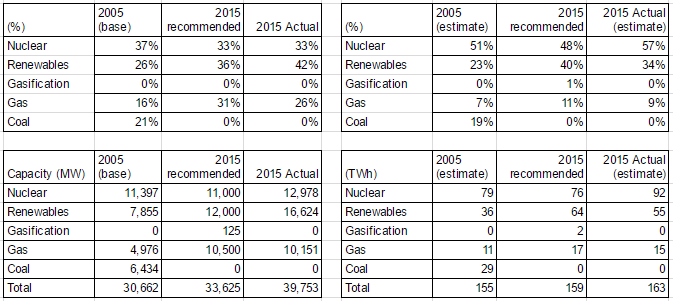
The OPA suggested to the Minister that by 2025 "renewables" be 15,500 megawatts (MW) - inclusive of about 8000 MW of existing hydro capacity and most likely the 1,250 MW increase in the Ontario-Quebec intertie capacity. [1]

Six months later, in June 2006, a Supply Mix Directive from the Minster tasked the OPA with the development of an IPSP (plan) including:
Increase Ontario's use of renewable energy such as hydroelectric, wind, solar, and biomass for electricity generation. The plan should ... increase the total capacity of renewable energy sources used in Ontario to 15,700 MW by 2025.
The IPSP final form, delivered August 29, 2008, planned for 16,164 MW of renewables by 2025: 10,768 MW of hydroelectric, 4,251 of wind, 656 of bioenergy and 488 MW of solar. [2]


opa2005to2015actComp
Spreadsheet comparing OPA Supply Mix Advice from 2005 to estimated actual 2015 data.
1st posted in Reviewing a 2005 plan for Ontario’s electricity supply in 2015
19 days later, on September 18th 2008, a Minister of Energy and Infrastructure essentially killed 3 years of work with an unintelligible directive amending the 2006 Supply Mix directive.

Friday, January 22, 2016

Beyond expectedly high cost: 2015 Ontario Electricity Summary Part 3

During 2015 most Ontario consumers experienced a 12% rise in the commodity price of electricity. The figure is higher than the 8% average annual increase over the past 8 years, but follows the trend of rate increases that was predictable, and if predictions had been heeded properly, largely preventable. In this post I'll note the actions driving the cost of a kilowatt-hour for the common Ontario ratepayer 85% higher over the past 8 years.

In my first post summarizing 2015 figures, I graphed the annual increases in the global adjustment and accompanied declines in the costs recovered through market sales. From 2007 to 2015 the total cost of electricity supply in Ontario grew from around $8.8 billion to $13.7 billion. The move away from recovering costs through market sales is important, but to find the most basic cost drivers we should first find elements of the $4.9 billion supply cost increase, and then explain the rate escalators taking the 55% increase in supply costs to an 85% increase in the supply price for most Ontario ratepayers.

Unexpecting the expected.

If cost increases still surprise some, it must be that the topic is too complicated for most, because clear warnings have existed. Price forecasting took a huge jump in Ontario with Bruce Sharp's August 2010 report prepared for the Canadian Manufactures & Exporters (CME). Prior to the report the price speculation attached to an escalated push into renewables came from the push's instigator, George Smitherman: "We anticipate about 1% per year of additional rate increase associated with the [Green Energy and Green Economy Act] bill’s implementation over the next 15 years." [2]  Sharp's August 2010 estimates put the cost much higher - at about $30/megawatt-hour (MWh) for the renewables supply with additional cost for distribution and transmission charges due to the Green Energy and Green Economy Act. The provincial Long-Term Energy plans following Sharp's report seemed to adopt his numbers, and consequently his forecast altered the reality slightly. Nonetheless, 2015's enormous $9.96 billion global adjustment total is only 2% off the total Sharp predicted in a second report 4 years ago.

Up we went

In my second post summarizing 2015 figures I demonstrated my estimates, inclusive of cost for distribution-connected (Dx) supply, largely agreed with the planned expenditures attached to 2013's long-term energy plan. It is important to note the system operator [IESO] current reporting on 2015 totals is only for "supply connected to the high-voltage transmission [Tx] system." The IESO's Tx reporting, as I've previously communicated, provides an increasingly inadequate image of Ontario's electricity generation - and it's encouraging this is being recognized by sector commentators as diverse as Parker Gallant and Tyler Hamilton.
The following graphic demonstrates my estimates of all 2015 generation (including Dx) and related supply costs (including Dx and curtailment):

Calculation exclude other costs included in global adjustment (such as conservation spending". See footnote 1 data.


The IESO's failure to develop reporting on generation from contracted supply within local distribution networks is now missing reporting on about 10% of Ontario's supply costs - mostly attributable to solar panels.

Monday, April 28, 2014

LTEP 2013: An unfinished plan

The Wynne Government's Achieving Balance: Ontario's Long-Term Energy Plan (LTEP 2013) isn't an energy plan; it's an electricity policy statement.

LTEP 2013 is inadequate; in it's sole focus on electricity, it does not address energy security and it does not address greenhouse gas emissions.
Ontario's electricity sector emits less CO2 equivalence than each of the car, light duty truck, diesel vehicle, and other residential energy consumption (furnace, gas) sectors. [1]  

The winter of 2013-14 showed an increasing linkage, in Ontario and other markets (particulary New England) of natural gas and electricity. Cold weather strained natural gas supply, threatening blackouts and sending prices soaring.

LTEP 2013 is therefore too narrow-focused to be an energy plan, and that limitation makes it unlikely to be a thorough electricity plan.  To the extent a plan exists, it anticipates increasing emissions from electricity generation while failing to plan for sufficient production to securely meet demand in a future that is, in planning terms, too close for comfort.

What LTEP 2013 "plans" on doing is continuing the mistakes that have driven prices up in the province since 2008.

The 5 principles of LTEP 2013

Thursday, February 17, 2011

Ontario’s Government’s Final Act in Electricity System Planning Farce

Less than one week after saying there wasn’t enough research to proceed with off-shore wind, reinstating the moratorium lifted 2 years ago, and returning to a time when there wasn’t enough research, the government issued a release today stating ”Long-Term Energy Plan Takes Another Step Forward.”    The off-shore wind is now simply planned for on-shore - most probably very near the shores of Erie, Huron, and, Pickle Lake.

Friday, February 4, 2011

Hey Kid, can you lend me $50 million for something Smart?

An article begins with "The Canadian Province of Ontario has announced plans to launch a $50 million smart grid initiative aimed at driving investment in research, capital and demonstration projects."
They didn't do that on any Government of Ontario site I can locate.

If by announced you mean whisper it in a foreign jurisdiction through a City of Guelph employee aligned with yet another organization with yet another adorable name (Ontario Clean Technology Alliance) made up of yet another grouping of different local governments - well, maybe they did announce it.

Some things not in the announcement:

Monday, November 29, 2010

Comment on the Draft Supply Mix Directive

I will comment on the directive, in this blog and anywhere else possible, but the title is directed at the reader. The last section of the directive notes a 45-day period for commenting started November 23rd, and public input is considered. I emphasize this as the Long Term Energy Plan , in Appendix Two, notes 2500 online responses were made as it was being formulated, between Sept 21st and Nov. 18th.

Sunday, November 28, 2010

Thoughts on the Long Term Energy Plan

I read through the Long Term Energy Plan on Tuesday. I've felt I should have strong opinions on it, but there was very little new it.

The plan is only about electricity, and contains no discussion about discouraging the use of natural gas, gasoline, or any other form of energy. That may be nitpicking , but immediately any truly environmental efficiency programs built around increased efficiency from more central heating/cooling servicing for new communities, combined heat and electricity, and electrification of transit seem off of the radar.

Friday, November 19, 2010

The Current and Future State of Electricity, as the OCEB comes to Ontario

Big news yesterday as the Finance Minister Duncan announced the Ontario Clean Energy Benefit (OCEB), which will bestow a credit of 10% of our bill upon us. The release by the government indicated the move to cleaner energy has been expensive, and would be so for another 5 years, so this should alleviate some of the pain being felt due to this noble endeavor; "Over the next five years, residential electricity prices are expected to rise by 46 per cent, after which price increases are expected to moderate as Ontario will have largely completed the transition to a cleaner, more reliable system."

I'm skeptical. Somebody said if you want to know where you are going, you need to know where you are, and where you've been. Seems like a good time for a big picture overview, a review of the current price drivers on the consumer side, on the industrial side, and to take stock in whether the government has any credibility in implying there is a planned destination, and a plan for arriving at it, in 5 years time.