Showing posts with label Wind. Show all posts

Monday, February 12, 2024

Anti-Nuclear by necessity

On January 30th the government of Ontario, currently headed by Doug Ford, announced it was advancing the refurbishment of the four “B” reactors at the Pickering Nuclear Generation Station (PNGS), Initial media response has been largely positive, with Ontario’s public broadcaster (TVO) noting, “ it’s hard to see a future government changing course”. Apparently TVO, and other news outlets, felt compelled to offer their readers articles opposed to the refurbishment for balance. At TVO the negative response came shortly after the news broke in an article by Taylor C. Noakes. Rebutting that work is one goal of this one, but it may be more important to explore the emerging tools for producing an article to counter a narrative in another.

There is a commendable aspect of TVO attaining the work by Noakes, who I believe to be ‘stringer’ - which is an independent producer of content: Noakes has produced multiple articles for, at least, TVO and Desmog, on a wide variety of topics. If you wanted an article with a perspective, Noakes is exactly the type of person you’d go to - particularly, if you’re familiar with Desmog and want an anti-nuclear position. The most obvious alternative approach, and the one taken by The Globe and Mail, is to publish an op-ed from a career antinuclear personality. Mark Winfield’s The folly of Ontario’s nuclear power play (subscription) is exactly what you’d expect from a person with a career based on opposing nuclear - I’ve previously highlighted his mid-2000’s publication at Pembina that planned for a nuclear-free Ontario by 2020 that would have had electricity-sector emissions 400% higher, and will simply emphasize that his status as an expert relies not on the the wisdom in his past work, but simply in his opposition to nuclear power.

Noakes’ stringer work may be enhanced with the emergence of Artificial Intelligence (AI) tools. Given a topic a writer can simply use an AI tool such as that embedded with the Bing browser, or OpenAI’s tools (I tested only the free version), and get the skeleton of an article. Bing’s Co-pilot, responding to my prompting, “argument to oppose refurbishment of Pickering nuclear generating station”, produced bullet points supporting 5 themes: Environmental Concerns, Cost and Overruns, Safety and Aging Infrastructure, Changing Energy Landscape, and Public Consultation and Transparency. ChatGPT gave paragraphs supporting 7 possibilities for opposing: Cost, Safety Concerns, Environmental Impact, Technological Obsolescence, Public health, Opportunity cost and Community opposition. These themes do emerge with every announcement of continued nuclear operations.

To acquire an article opposing nuclear power in 2024 a polymath isn’t required, but mostly somebody who can wrap readily attainable content in a story. Noakes’ TVO story is titled:

The Ford government’s decision on nuclear will set Ontario back 30 years
OPINION: Our politicians keep subsidizing old technologies and industries — and putting opportunity and ideology ahead of basic economics

That sets the stage: a villain is presented (Ford, who heads what is actually Ontario’s government - but Ontario can’t be the villain), driven by ideology instead of rationality (a.k.a. ‘Basic economics’). You can almost hear a pantomime’s audience booing the modern “not following the science” villain..

Friday, March 1, 2019

Value lessons from Ontario electricity statistics

Data - and lots of it.

While I'll try to prevent this post from sliding into an abyss of Ontario electricity statistics, I'll be citing provincial data as the basis for discussion about public understanding being restricted by the presentation of data from official sources, and present new views of generally unreported data that would benefit literacy in valuations of electricity sources - an area where reckless ignorance blooms again and again.
but enough about academics, let's dive in!

The old standard of valuing generation sources is the Levelized Cost of Electricity (LCOE ). I was particularly pleased in late 2015 when a report from Ontario's Auditor General included a figure (5) indicating the cost and quantity of energy sources for 2014. I was more pleased a few years later when I received figures from a freedom of information (FOI) request with the same information for years 2007-2015. While I think the data is terrific, when I wrote about it I cautioned on presenting LCOE, "stressing these calculations deserve a big asterisk and lengthy footnote on the impacts of things such as curtailment and capacity payments." 

I have now done the data work required to add that lengthy footnote on curtailment and capacity payments.

I am certainly not unique in hoping for superior valuation tools to LCOE: the U.S. Energy Information Administration (EIA) has developed a  Levelized Avoided Cost of Electricity (LACE) metric, and the International Energy Agency (IEA) a Value-Adjusted Levelized Cost of Electricity (VALCOE - see pg 41). LACE is intended to value the cost (of alternatives) avoided by the generation, with the intent LACE > LCOE would signal a good project. VALCOE attempts to recognize the different capabilities of sources in providing firm capacity and flexibility. The specifics are less important than the principles: not all generation is of equal worth to systems that are intended to minimize loss-of-load situations. Concrete examples of LUEC's limitations will help conceptualize the issues that have people looking for better valuations.

Before I discuss my data I will note one other frequently cited source of Unit Cost in my province (I regard LUEC and LCOE as interchangeable terms): the Ontario regulator. Their most recent explanation of regulated rates includes a table (3) indicating hydro at 6.2 cents per kilowatt-hour, nuclear at 7.7, wind at 15.9, gas at 18.8 and solar at 51.3 c/kWh. I'll show replacing the OEB list's lower cost supply with gas is likely to lower total costs.

I have collected hourly data for the transmission-connected (Tx) generators reported by Ontario's system operator, including imports, and I've estimated (hourly) distribution-connected generation (Dx), curtailed supply, and contracted cost, either by unit generated (or curtailed), or by capacity required to be available. My base union query in working the data has over 16.4 million records. I will not repeat the word "estimate" in this post but simply note this one time it may be applied to everything (my work and the numbers from the IESO and OEB I cite).  

Here is my summary of annual generation and costs from 2008-2018:

Saturday, August 4, 2018

Ontario's rotten wind era at its end

There are three stories from recent news indicating the poverty of competence in Ontario's industrial wind turbine tale. Two occur in bucolic counties near the eastern end of Lake Ontario, the other just south of the forest fire burning in French River Provincial Park - where the fire originated. Most discussion of industrial wind in Ontario is delivered in a narrative of good (renewables) and NIMBY (not in my backyard). Occasionally somebody wades in pretending there's a business angle, so I thought I'd rebut that ignorant assessment while commenting on the three recent wind stories.

The foundation for the post has to be a little dry.

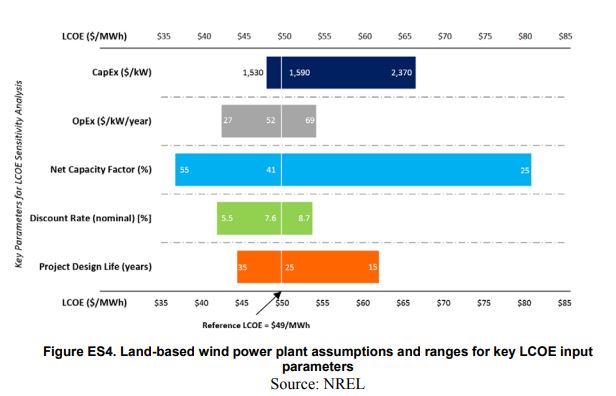
The world of cost estimates for electricity is complex, but it's not hard to understand the capital expenditure (CapEx) per Watt of generating capacity is important element. This excellent graphic, from the respected National Renewable Energy Laboratory (NREL) 2016 Cost of Wind Energy Review, puts CapEx at the top of its cost parameters stack


At today's currency values the U.S. report's $1530-$2370/kW range equates to a $2000-$3100 in Canadian dollars.

The NREL report builds on figures from the U.S. Department of Energy 2016 Wind Technologies Market Report. Drilling into some numbers shared for that report reveals most projects were built with CapEx below $1800USD/kW ($2360CDN/kW), and that in real dollars that $2360CDN/kW is an above average cost over the past 20 years.


It is also notable that the highest pricing of the past 2 decades, per Watt of capacity, occurred about the time (2009-10) Premier Dalton McGuinty introduced Ontario's lucrative feed-in tariff contract mechanism - or perhaps it would be more correct to say Ontario's Premier introduced Germany's feed-in tariff contracts to Ontario.

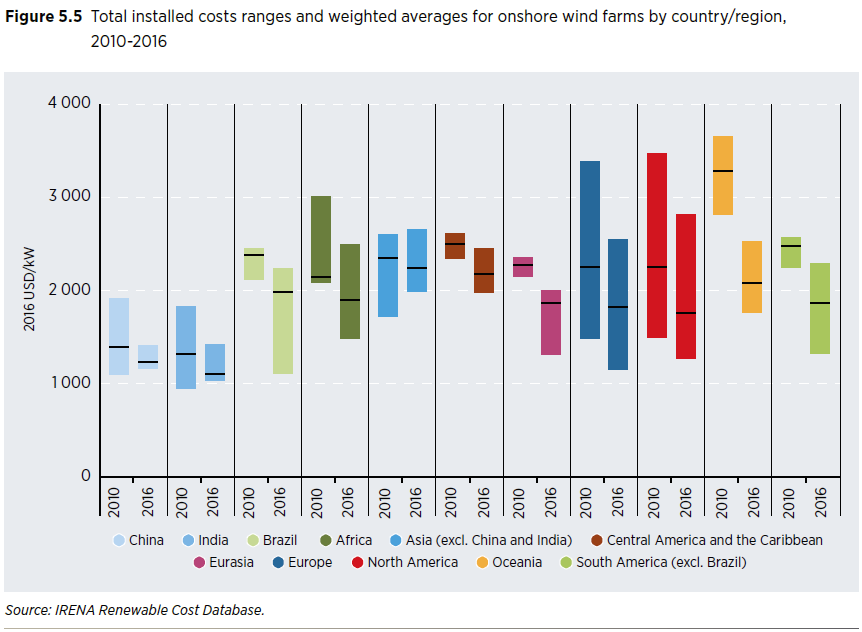
The International Renewable Energy Ageny (IRENA) Renewable Power Generation Costs in 2017 report agrees with NREL's figures, and notes similar 2016 weighted average pricing for onshore wind in North America, Europe, South America (excluding Brazil), and Eurasia. Call it $2,400 Canadian per kilowatt of onshore industrial wind turbine (IWT) capacity.


This background on capital expenditures (CapEx) in constructing industrial wind turbine projects provides a basis for analyzing 3 Ontario projects that have recently been in the province's news.

Monday, April 16, 2018

Carbon-Con: ECO communication

A couple of weeks I was asked about potential ways to collaborate with reputable sites. I put some thought into that before responding that simply an association with me could bring a site to disrepute, but my thoughts on communication persist. From the belligerent uttering of a federal Minister on a Sunday talk show, to a media blitz from an organization marketing itself as expert on economic tools to reduce carbon emissions, to the Ontario report I'll feature in this commentary, it's been as if a convention of climate change alarm is occurring.

A Climate convention.

Comic Con (short for convention) is a really big event now, which makes some sense in this era of communication. Text is a low impact medium - the sites adding audio and video, integrating with podcasts, have a huge advantage. As the comic and related genres (science fiction, fantasy and superhero) grew from print to screens of all sizes, the graphics and sound growth has simply piled success onto success. The term "simply" recognized almost all characters can be grouped into good or bad.

Perhaps due only to my musing about communication, collaboration and branding, I thought the polarized nature of climate, and energy discussions, make Comic Con a model for communication and promotion in the 'clean tech' industry.

I'd prefer to be a hero, but realize the model needs villains too.

What I hope will be found in my little section of this Carbon Con is data-driven iconoclasm delivered through research, competent data handling, pointed if not visually appealing graphics, and full contact criticism of those blissfully unaware they deserve to be blisteringly opposed.

What many will find is villainy - I've been accused as anti-wind, anti-renewable, anti-conservation, pro-nuclear, disrespect and misogyny. I don't agree with that entire list, but I'm okay with being the villain if it makes for better heroes.

My concern with the profession of professing concern about carbon emissions begins, as most things do, with religion.

Thursday, March 1, 2018

Review of 2017 electricity supply in Ontario

You purchase a  full 9-unit container of energy .
The 3 men who deliver it pour out 2 units out while lecturing on consumption. 
They imply you should make more yourself as they leave.

A couple of months have passed since I last posted to the blog. This may be due to writer's block, or a lack of ambition - or maybe I was wisely waiting until I had something nice to say!

With growing knowledge, and curiosity, I seem to muddle all little issues into the broad themes I deem important - and not only for energy. In this post I'll touch on metrics from 2017 the reader may be looking to this blog to find, with hopes of connecting the data to bigger issues.

There are many possible headlines from an annual analysis:
  • electricity "demand", as reported by the system operator was down, to levels not seen in decades
  • supply generated from fossil fuels (natural gas) was sharply down too, and again to levels probably not seen in over over half a century
  • prices for consumers on regulated price plans were sharply down in 2017 due to legislation and consequent debt (the [un]Fair Power Plan), but,
  • total costs for supply declined in 2017, although average unit cost was up slightly (as demand declined more)
  • nuclear supply was down as one unit (Darlington 2) was out of service for the entire year due to refurbishment, but the units remaining online largely took up the slack as Bruce Power had record output, as did the set of 9 units at Ontario Power Generation which operated during 2017, and
  • for the first year since the system operator reported on their system's wind output, in 2006, it reported a decline (albeit a very slight one)
I didn't wish to dwell on numbers in this post. During 2017 I learned some new data reporting tools which I put on on a site where I invite data-gluttons to learn the filters and views to generate the typical year-end summary statistics, such as the total annual biomass generation for the past decade.
I do wish, in this post, to combine commentary to statistics to demonstrate very good figures from one perspective can have bad implications from a broader perspective. This is particularly important to note as the reasons rates didn't rise sharply in 2017 aren't sustainable.

Thursday, November 9, 2017

Alberta. Bound.

The government of Alberta has a plan to "reduce carbon emissions."
Their plan restricts the ability of the province to efficiently minimize greenhouse gas emissions.

The three aspects of the Alberta's "Climate Leadership Plan" most relevant to the electricity sector are:
  • implementing a new carbon price on greenhouse gas emissions
  • ending pollution from coal-generated electricity by 2030
  • developing more renewable energy
I've seen my province - Ontario - cited as an impediment to growing renewable energy in Alberta. This is understandable from a cost perspective, but if reducing emissions were the primary goal Ontario's example would be encouraging, as its emissions from generating electricity are a fraction of Alberta's.

I realize most Albertans are not awaiting opinions from Ontario, but I'll trust my analysis will be of interest to some in Alberta, and some elsewhere. Alberta is simply the sample case I'll use to argue specifically banning coal-fired electricity is unnecessary, and quotas for renewable sources to provide a fixed percentage of supply a little worse than that. This is not to argue for coal or little supply from renewables. Functionally, what I'll point to as better policy is likely to result in similar outcomes. I intend to demonstrate rules are being gamed to predetermine an unambitious outcome at the expense of achieving greater things.

A brief review of Albert's electricity system will be helpful prior to discussing the growth of renewables and elimination of coal. 

Figures are collected from AESO annual market statistic files (year 2013-2016) 

Available figures for Alberta's electricity generation include the percentage of electricity produced by generation technology. Unfortunately some categories change in 2010, but whether 2016 is compared to 2010 (the earliest year of the current categories) or 2004, coal has lost the greatest market share, and it has lost it to wind (probably the greatest change since 2004, natural gas (Combined Cycle gas turbines had the biggest 2010-2016 growth) and "Cogen" (for co-generation). Coal does continue to have 60% market share by this measure, so adding renewables until they have a 30% share seems doable - but it's more difficult depending on the definition of the market.

Sunday, October 15, 2017

A gathering in Prince Edward County

Today in Picton people will assemble at a rally against what has become a 9 turbine industrial wind development in a ecologically sensitive area near Lake Ontario. I won't be attending as it's a 3-4 hour drive away, but I will contribute by arguing the existence of the contract for the location, at this time, is indicative of negligence at Ontario electricity system operator (IESO).

Details at the Prince Edward County Field Naturalists Facebook page
This rally coincides with a legal action launched by the Association to Protect Prince Edward County (APPEC). 
APPEC has commenced legal proceedings naming the Independent Electricity Operator (IESO) and WPD White Pines Wind Inc. (WPD) as respondents. APPEC alleges that the Feed-In-Tariff (FIT) contract between the IESO and WPD should have been terminated as soon as it became evident that WPD would be unable or incapable of fulfilling the FIT contract terms. These FIT contract terms have been made publicly available and are well known.
In 2010, a FIT contract for 60MW wind energy project to be operational within three (3) years was offered by the Ontario Power Authority (now the IESO) to WPD. The contract allowed for termination if the project was not able to deliver at least 75% of the contracted power.  -APPEC (on Facebook)
The inability to deliver 75% of contracted capacity is but one of the reasons WPD cannot now fulfill their end of the feed-in tariff contract.

Friday, September 29, 2017

Ontario Electricity Operator brags of ICI subsidy, continues spending on wind experiment

7 days after news broke of a lawsuit claiming the global adjustment charge is “an unconstitutional tax, not a valid regulatory charge,” Ontario's electricity system operator (IESO) issued a news release congratulating their generators and certain consumers:
Ontario’s peak demand days typically don’t happen at this time of the year. Yet with hot weather persisting, and in spite of summer’s end last week, the province experienced new annual peaks this week of 21,786 MW on Monday and 21,542 MW on Tuesday.
Generators did their part to help meet the peaks, as well as Ontario’s consumers participating in the Industrial Conservation Initiative (ICI) and other demand response initiatives.
According to preliminary analysis, consumers participating in the ICI are estimated to have reduced peak demand by over 1,500 MW this week. By reducing demand during peak periods, ICI participants can both reduce their electricity costs while helping to defer the need for investments in new electricity infrastructure that may otherwise be needed.
They didn't mention if the 21,783 MW remains 2017's annual peak it will be a record annual low (the 3rd one recorded in the past 4 years).


Saturday, August 26, 2017

regarding Ontario Electricity Generation and Costs, 2007 - 2015

This week I was handed some data indicating, by supply type, electricity generation and costs in Ontario. The data was a hard copy response of the IESO to a freedom of information request. There's nothing in the data that will surprise readers of my work, but perhaps it's time for a refresher, as today I read one flip comment by a mainstream journalist, joking they'd like to see "Ontario families can no longer afford skyrocketing nuke costs," and an opinion piece on the public broadcaster's site which included:
...as data from the [International] Electricity System Operator clearly shows (sic), it’s nuclear and gas plants that are responsible for the lion’s share of increases. 
"Clearly."
It is time for a refresher.

Some background on the data I'll share. The 2015 Annual Report from the office of The Auditor General of Ontario included a chapter on "Electricity Power System Planning." The entire chapter contained a wealth of information and continues to be cited frequently, but for those chasing hard numbers one particular star of the work was a figure revealing the quantity, and cost, of generation from various sources, inclusive of not only the larger generators frequently reported by the IESO (the "I" is not for international, but it is the electricity system operator), but also the seldom reported distributed generation - which is where most solar exists.

The freedom-of-information requests handed to me included this request:
Breakdown of Generation Cost by Energy Sources for the years 2007, 2008, 2009, 2010, 2011, 2012, 2013 and 2015. The Breakdown for 2014, which was included in the Annual Report of the Auditor General of Ontario, is attached as reference.
The data table that follows responds fully with the request - I have only reformatted it:

Wednesday, June 21, 2017

A citizen's map of Industrial Wind Turbines in Ontario

I have produced and put online an interactive map of Industrial Wind Turbines in Ontario. Having done so feel I should explain why, and how, and invite others to participate in improving data.

The map is embedded later in this post, as is a YouTube clip of me talking to its design and functionality.  I talked for longer than I expected, and I suspect I shall write on this longer than I expect too, because I think the issues of public data availability is important, and I have a particular fascination with data mining, manipulation, presentation and technology.

There was a paper published late in 2013 titled Mapping Ontario’s Wind Turbines: Challenges and Limitations. The abstract began:
Despite rapid and vast development of wind turbines across the Canadian province of Ontario, there is no map available indicating the location of each wind turbine. A map of this nature is crucial for health and environmental risk research and has many applications in other fields.
These seem like noble goals, so it might be surprising there's not a single official source of spatial data 3-4 years later.
The scope of the desired map was described in the paper:
A map showing individual wind turbines would be a valuable resource for researchers to examine health effects, as the distance that a resident lives from a wind turbine could act as a proxy indicator of a "dose" and could be used...
This is one example, but it could be measured against a lot of things - bat counts, bird carcasses, house and farm values, household income. The possibilities need not be known, only the data requirements, and most of these were described well years ago.

Monday, June 5, 2017

Ontario electricity: How we got to here

It is the best of times, it is the worst of times.

The best: over the first five months of 2017 the reporting from Ontario's system operator (the IESO) indicates less than 2 terawatt-hours (TWh) of electricity has been generated from natural gas fueled facilities, with the remainder of 59 TWh generated on the IESO system coming from near-zero greenhouse gas emission sources. Since April 2014 coal has not been burned to produce electricity in the province. Emissions intensity of generation over the first 5 months of 2017 is approximately 14 grams of CO2 equivalency per kilowatt-hour (g CO2 eq / kWh), which is particularly low for a jurisdiction receiving less than 30% of its generation from hydro-electric sources.

Some things will be viewed as good, or bad, depending on the perspective of the observer: the last two months demand of IESO supply has been lower than in any month since 1994. If "conservation" is good, it would seem Ontario has it good. Supply is plentiful. So plentiful the IESO reported 19 per cent of of "wind energy produced in the province" was dispatched down (curtailed) in 2016, and Ontario Power Generation (OPG) reported 16% more hydroelectric generation could have occurred if not for surplus supply. The numbers on the surplus in 2016 are noteworthy: 7.6 TWh curtailed equates with 5.5% of the 137 TWh "withdrawn from the high-voltage transmission system by Ontario loads", but a further 21.8 TWh was exported meaning total supply (including imports) was 21.5% more than those loads required.

Some things are now viewed as bad, that were previously viewed by some as good. Regulated Price Plans charging residential, farms and other small business consumers what the government had longed planned to have them paying are suddenly being cut steeply through a debt scheme to be paid off whenever down the line. In order to keep cost hikes in line with previous projections the government already had to abandon first the collection of a Debt Retirement Charge and then the provincial portion of the Harmonized Sales Tax - some feel the lower government revenues a negative.

I've written often on the causes of higher rates in Ontario. I am inspired to do so again by the uncovering of documentation from a previously hidden Integrated Power System Plan in 2011. Shawn-Patrick Stensil, of Greenpeace, acquired the documents through a long Freedom-of-Information (FOI) process.

This post examines 3 long-term plans' annual forecasts of Ontario's electricity supply mix, with a focus on the capacity mixes forecast for 2016 compared to the current actual supply composition.

The current situation is not accidental.

This is how we got to here

Saturday, May 13, 2017

Fairly perverted: Ontario's "Fair Hydro Plan"

On March 2nd the Premier of Ontario introduced the "extend and pretend" plan to lower electricity rates for voters prior to the next election; on May 11th the government introduced its "Fair Hydro Act" bill shortly after the opposition Progressive Conservative's released an allegedly leaked cabinet document. The general content revealed contains some interesting details confirming what was suspected: the Premier's plan is cynical and irresponsible.

A quick refresher on events to date:

  • people are angered by electricity rates
  • there is an election in 2018
  • the Premier is unpopular
  • the Premier promised a 25% cut in rates.

Background:
On the original announcement in March: Extend and pretend: Ontario government acts to lower electricity bills 
This post will use some of the new material to emphasize why rates are high, what extending the payment period implies, and how the government intends on keeping the costs of the program off of the Province's balance sheet.


The Premier's "fair" plan isn't entirely about the cost of generation, although I'll concentrate on that. It includes moving some social costs off of ratepayers' bills and onto government expenditures, and abandons the provincial taxation share of the HST.  My reading of the new bill is that it mandates the reduction of Regulated Price Plan (RPP) rates be 25%. [1]

Now that we know the commodity portion of the bill is being reduced 25%, we can be more definitive about what is being subsidized, by whom, and the fairness of the policy.

Sunday, March 19, 2017

ON Electricity pricing 2: the ugly other

The recent release of annual 2016 financial results for Ontario Power Generation (OPG) completed data requirements for updating one of my favourite, and I suspect most impactful, spreadsheets.

I was particularly curious to find out which generator was the lowest priced of them all in 2016.

By my measurements, it is Bruce Power.


While I was anxious to see the annual figures in this old format, what impacted me the most from the graphic is that 10 years ago there was some consistency in pricing. Since that time there's been some movement in public OPG's pricing of its traditional hydro-electric and nuclear assets, even less change at nuclear Bruce Power, but enormous changes in the average cost of "other Ontario" generation.

Explaining the changes required some explanation of the data, my methodology, and the changes in the composition of "other" generators. Upon creating the explanations, I realized I could improve my original spreadsheet. If you see some variations to my previous posts, it's because this is the improved version.

Saturday, March 18, 2017

ON electricity pricing 1: retail math and green tales

It's not uncommon to hear a claim made that green energy can't be responsible for the steep increase in Ontario residential electricity rates because it's only around 10% of the total bill. This post could demonstrate calculations using 10%, but it is nearer reality to start with 15% in demonstrating why the argument deceives.

I disputed some claims by Environmental Defence a month ago, but I've used their figures in calculating 15% of the total bill. I did this by simply adding "conservation" in the calculations - while the report I criticized underestimated the cost of solar and (less so) wind, it overestimated the cost of conservation. Together these 3 would have been about 0% of bills a decade ago (2006), and in 2016 they were about 30% of the global adjustment, 28% of all Ontario supply costs (by the ED reports numbers), and since ED has that supply cost as 54% of a residential bill, they claim about 15% of the bill. 

Let's ease into some primitive math using figures we already know. How much does 54% of your bill need to increase for the total to move up 15%?
0.15 divided by 0.54 = .28.
There's the 28% increase in supply cost I noted in ED's figures. There's an assumption, probably incorrect, that supply was always 54% of the bill, but I'll keep things as simple as possible: a 15% increase in the total bill, all other things being equal, required a 28% increase in costs.

As wind, solar and conservation added negligible cost a decade ago, it's worthwhile asking how much spending in these areas increased overall electricity generation cost (ignoring the rest of the bill). It's not 28%:
1 divided by 0.72 (which is 1-.28) = 1.38888....
Costs are increased by 39% when adding new spending that then equals 28% of the new total.

Wednesday, December 21, 2016

Historical ignorance: on energy losses in decadent Ontario


Accusations of losses on electricity exports, and government denial of the fact, is far from news, but the reappearance of the topic in Ontario's legislature demands it be reviewed anew.
Progressive Conservative Leader Patrick Brown says the province sold $9.4 million worth of excess electricity for just $144,000 on Nov. 10...
Brown says Ontario has "given away" $6 billion in surplus electricity since 2009 by selling it at a big loss...
Energy Minister Glenn Thibeault...says Ontario made $230 million in 2015 by selling excess electricity to neighbouring jurisdictions.
Thibeault says Ontario suffered through power shortages and brown outs when the Conservatives were last in power, and had to spend up to $500 million a year to buy electricity from its neighbours to keep the lights on.
   -the Canadian Press via ctvnews.ca
I wrote on the costs to Ontario ratepayers of cheap exports almost 6 years ago, in rebutting the same spin as the Minister delivered yesterday when presented by a previous Premier. Later, in 2013's Ways to estimate Ontario's losses on electricity exports I demonstrated multiple methods to quantify losses on exports. The estimates of losses vary by methodology and assumptions, but if methods are applied consistently all indicate increased costs to Ontario consumers from producing far more electricity than necessary to meet their demands .

I won't revisit all the arguments I've made in the past, but instead tailor a response to the rookie Minister's old denials, emphasizing how poorly he is prepared to undertake the task of developing a plan for the sector.

Tuesday, November 22, 2016

something about electricity rates: the Premier's mistake

Premier Kathleen Wynne is calling high electricity prices her “mistake,” begins a report on her speech at the Ontario Liberal Party's annual general meeting. The statement would appear sincere if accompanied by an explanation of exactly what she thought her mistake was. As a political tactic, as I think it is, it's a good move in positioning the Liberal party for the election coming in 2018.
...a contrite Wynne told 850 Liberal delegates at the party’s annual general meeting here that her “government made a mistake” by allowing rates to soar.
“It was my mistake and I’m going to do my best to fix it,” she said...
Tactically, I think the move is based on two things:
  • the political rule that the electorate's anger is not sustainable
  • most expensive electricity contracts have now entered service and, combined with OPG's poor rate application, upward pressure on rates was, and is, planned to be less severe over the next couple of years.
These realities may allow the Premier to now position herself as responsive to people concerns. Adrian Morrow's report shows how she'd like to end up positioned for the 2018 campaign:
“I will do my very best to listen, to respond, to lead, and to serve you and the people of Ontario better,” she said. “I will be right there with you: As premier, as leader, I’ll be there with you as Kathleen, a proud mother and grandmother.”
These are the factors that put some wind in the sails of Wynne's Liberal ship. An article by Robert Benzie notes some of the content presented to the assembled Liberals by master strategist and Liberal campaign chief David Herle:
Even though [opposition leader] Brown publicly broke with social conservatives in August — saying he supports abortion rights, same-sex marriage, and the modernized health lesson plan — Herle’s findings suggest the Liberals plan to paint him as one.
Simply put, the Ontario Liberal Party is positioning the party for a culture war - with a caring grandmother running against a jerk.

It's a promising but risky tactic.

Monday, September 12, 2016

Communication, Politics, Money: Wynne's electricity/electoral strategy

The Premier of Ontario launched a campaign advertising her concern about the impact of high electricity rates in proroguing the legislature, which allowed for a New Speech from the Throne setting government priorities. The speech announced a new policy for residential electricity consumers, re-implementing an old policy but providing an excuse to discuss the communication strategies impacting the electricity narrative in Ontario - among the political parties, and allegedly public servants.

A brief reverse timeline on tax policies and electricity in Ontario:
  • September 12, 2016 the Wynne government announces the provincial portion of the Harmonized Sales Tax (HST) will be rebated on residential and small business consumer bills as of January 1, 2017;
  • January 1, 2015 the Wynne government removes the Ontario Clean Energy Benefit (OCEB) that deducted 10% of residential electricity bills
  • January 1, 2011 the McGuinty government (same party) introduced the OCEB
  • July 1, 2010 the McGuinty government adds 8% to residential electricity bills when the Provincial and Federal sales taxes are harmonized as the HST
Let's not pretend that today's announcement is creative or terribly meaningful, but uncover the limitations that prevent the Premier from doing something meaningful to control costs - or allow her to let rates rise higher.

David Herle is an influential political strategist notable for co-chairing the Premier's successful 2014 election campaign. In February (2016) Mr. Hearle delivered a presentation to the Canadian Nuclear Association (CNA). The first point Mr. Hearle had on his slides was:
Rates are an increasingly major concern in Ontario. The cost of electricity is not just seen to be unreasonably high, it is widely seen as damaging to the provincial economy. 
  • Slowing rate increases is critical. 
  • Electricity is a necessity not a luxury.
A conservative strategist, Nick Kouvalis delivered a similar presentation to the Ontario Energy Association in the fall of 2015. That presentation also showed survey results indicating economy and jobs topped concerns, with energy prices not far behind.

Mr. Hearle noted some characteristics of public opinion that now drive Ontario Liberal Party public speaking on electricity. People like:
  • the elimination of coal
  • improved reliability
  • conservation
  • renewable energy (many remain positive on industrial wind - and most on solar)
Hearle, it seems to me, indicates a communication strategy that recognizes people don't want to blame cost hikes on things they like, and therefore Liberal policy is to challenge people to associate increased rates to the achievement of outcomes they desired - specifically coal's elimination in the generation of electricity, and alleged improvement to system reliability.1

Saturday, July 23, 2016

The growing subsidy of wind and solar in Ontario

I was recently asked the amount of subsidies paid to wind and solar generators in Ontario, and felt answering deserved a blog post. I will show that from the introduction to Ontario's transmission grid of the first industrial wind turbines in 2006 up to June 30, 2016, subsidies to wind and solar generators have been approximately $6.4 billion.
More important than the figure, are the trends in annual magnitude and composition.

I have tried not to use the word "subsidy" in recent years - having been guilty of using poorly in the past. However, it's increasingly clear to me that avoiding the "subsidy" discussion has been harmful to Ontario's ratepayers.

In Ontario the word "subsidy" is often quantified by the amount paid for electricity by consumers above the price of that electricity in Ontario's market. The method of recovering that amount is the global adjustment mechanism. The complicated system with huge figures (on track to hit $12 billion in 2016) meant great attention was paid when the Auditor General of Ontario reported, "[from] 2006 to 2014, electricity consumers have already paid a total of $37 billion, and they are expected to pay another $133 billion in Global Adjustment fees from 2015 to 2032." 


However, with all generators in Ontario now recovering some of their costs outside of the market rate, the global adjustment has become a poor tool for defining subsidy. Treating the global adjustment as a subsidy ignores that Ontario's weak electricity market isn't intended to recover all the costs of generation. When the market functions to provide any indication of generator cost, it is usually only the fuel portion of a natural gas-fired generator's expenses. This makes the global adjustment a poor definition of a subsidy - although it's a fine indicator of the poor quality of Ontario's electricity market.

Sunday, July 10, 2016

New wind study provides a good argument for nuclear power

Last Wednesday I posted my critique of a wind-water-sun (WWS) fantasy for Canada, which unknowingly coincided with the Canadian Wind Energy Association (CanWEA) release of a Pan-Canadian Wind Integration Study (PCWIS) 1. The PCWIS, primarily prepared by a branch of industrial wind turbine manufacturer General Electric, contains statistical work that should be of interest to those looking at capacity valuation, and its impact on electricity supply mixes. However, the basic data discipline indicated by the study is poor. Unfortunately a rather deep read of PCWIS is necessary to realize how unimpressive the expected impacts of adding industrial wind to Canada's generation mix are.

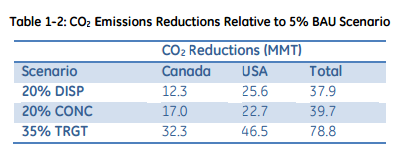
The main conclusion of the study is that building out the wind industry in Canada does very little to reduce greenhouse gas emissions in Canada.


The study was mostly paid for by Canadian taxpayers via Natural Resources Canada:
 "The project’s primary goal was to obtain insight into the challenges, opportunities, mitigation measures and operational tools needed to efficiently integrate wind energy into the grid. This has been accomplished by undertaking an integration study approach, which involves matching time series modelled wind energy production data with electricity demand data, and evaluating how this influences the rest of the electricity grid."
I'll evaluate the data work for Ontario, although some claims the study makes for other provinces also demand comment.

Wednesday, July 6, 2016

Wind Water and Sunlight: Jacobson's sorcery

Dreams of a future powered by wind, water and sunlight (WWS) have been spread by Stanford professor Mark Jacobson. Jacobson's work is more optimistic about the contributions to come from WWS than other projections, which may explain an infectious political appeal. In my country the allure of a WWS power supply is impacting Canada's most left political party, the NDP.

SK Premier Wall and Lead Leaper Klein exchange tweets
I've looked at the the WWS work and will demonstrate its shortcomings in Ontario, with the expectation that can be extended to all northern jurisdications. One inspiration for looking at the viability of WWS is opportunistic: Ontario, with a new Minister of Energy, is initiating another Long-Term Energy Plan (LTEP) process. The WWS work provides a test case to run through a data model I created for the previous LTEP planning, and refine my work as necessary.

I won't concentrate on Jacobson's work to nearly the extent of Jani-Petri Martikainen's convincing and entertaining Why does Mark Jacobson hate Finland? or multiple insightful articles at the "A Chemist in Langley" site, including the most recent, Debunking the Leap Manifesto’s 100% Wind, Water and Sunlight Annual Energy, Health, and Climate Cost Savings. I'll attempt to limit myself to briefly discussing how the WWS paper arrived at its supply mix for Canada, and testing that mix within an hourly model - the only way a mix can be rigorously tested.

The April 2016 draft paper from Jacobson and others, 100% Clean and Renewable Wind, Water, and Sunlight (WWS) AllSector Energy Roadmaps for 139 Countries of the World, concluded, "The study finds that the conversion to WWS is technically and economically feasible. The main barriers are still social and political." It's a grand claim for a draft exercise that claims only to,
"[calculate] the number of generators of each type needed to power each country based on the 2050 power demand in the country after all sectors have been electrified but before considering grid reliability and neglecting energy imports and exports."
WWS does not present itself as attempting any hourly modelling of an electricity system, building requirements solely based on total energy requirements for a calendar year.