Showing posts with label Supply Mix Directive (SMD). Show all posts

Sunday, April 17, 2016

10700: Ontario's beastly number

Planning Ontario's electricity sector should have been a topic of interest when, on December 2nd 2015, the province's Auditor General included a chapter on Electricity Power System Planning in her annual report. The report received a lot of attention, but our power system planning process did not. The fall of the arbitrary, yet long-standing, 10700 megawatt target for non-hydroelectric renewable energy would indicate a return of professionalism in planning Ontario's electricity sector.

Before 10700 was the Integrated Power System Plan (IPSP) process.

The Liberal government, elected in the fall of 2003, had created the Ontario Power Authority (OPA) largely to develop an IPSP professionally, if not entirely independently. The process had, in its early stage, the OPA prepare supply mix advise for the Minister of Energy. Some notable aspects of the December 2005 advice:
  • Preference for renewable sources of energy...
  • Renewables, including wind, small hydro (waterpower) projects and hydro purchased from other provinces (referred to as “hydro imports” in the balance of this report), can provide a significant share of capacity and energy...
  • ... conservation and new renewable sources would more than meet all of Ontario’s growth in demand for electricity by 2025. This would not, however, replace the loss of capacity from the retirement of other supply sources...
  • Together, natural gas and renewable sources can replace coal generation...
I've added emphasis, but quoted from the OPA verbatim.
The OPA suggested to the Minister that by 2025 "renewables" be 15,500 megawatts (MW) - inclusive of about 8000 MW of existing hydro capacity and most likely the 1,250 MW increase in the Ontario-Quebec intertie capacity. [1]

Six months later, in June 2006, a Supply Mix Directive from the Minster tasked the OPA with the development of an IPSP (plan) including:
Increase Ontario's use of renewable energy such as hydroelectric, wind, solar, and biomass for electricity generation. The plan should ... increase the total capacity of renewable energy sources used in Ontario to 15,700 MW by 2025.
The IPSP final form, delivered August 29, 2008, planned for 16,164 MW of renewables by 2025: 10,768 MW of hydroelectric, 4,251 of wind, 656 of bioenergy and 488 MW of solar. [2]
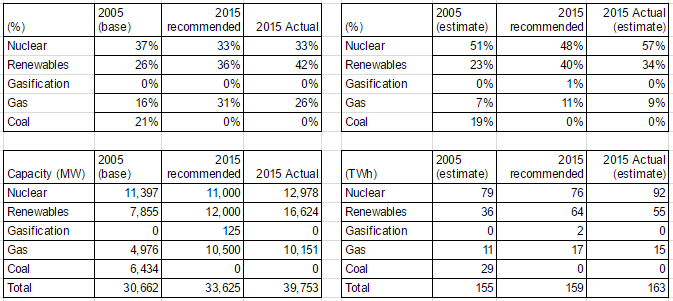

opa2005to2015actComp
Spreadsheet comparing OPA Supply Mix Advice from 2005 to estimated actual 2015 data.
1st posted in Reviewing a 2005 plan for Ontario’s electricity supply in 2015
19 days later, on September 18th 2008, a Minister of Energy and Infrastructure essentially killed 3 years of work with an unintelligible directive amending the 2006 Supply Mix directive.

Friday, November 11, 2011

Reviewing Ontario's Feed-In Tariff: Part 1

The Ontario government's announcement of a review of the Feed-In Tariff (FiT) program raised alarms among observer's of Ontario's electricity system.  The review has been put in the hands of a senior bureaucrat from outside of the electricity planning process, de-emphasizing knowledge of Ontario's electricity system..  The government developed a survey and wrote; "All Ontarians are invited to participate in the review of the FIT Program and can provide feedback by answering an online survey or making a written submission at 2yearFITreview@ontario.ca."    The government claims their review will "examine program rules and pricing to ensure the program remains successful and sustainable."  
Remains 'successful and sustainable'?
That is a disconcerting description, but the distortion seems even more bizarre in the official government survey.  Surely in order to comment on revisions to the plan, we should review the first two years to evaluate the accomplishments of the program thus far.  This is especially true as the first accomplishment was to halt comprehensive long-term planning of Ontario's electricity system

Thursday, January 6, 2011

Scott’s Submitted Comments on The Draft Supply Mix Directive

For anybody wishing to pursue commenting on the directive, or reviewing it, the online format is simply an online text box . The timeframe ends on January 7th . I therefore rushed this a bit, and didn't bother creating my usual, informative, graphics for the text box.

----------------------------------------


The combination of supply sources should be recognized as requiring expertise, and the Minister should be aware of his own limitations in directing electricity system engineers, and other professionals, in getting too specific. I would hope the intention of the Minister is to present the parameters for professionals to operate within.

-----------------

Monday, November 29, 2010

Comment on the Draft Supply Mix Directive

I will comment on the directive, in this blog and anywhere else possible, but the title is directed at the reader. The last section of the directive notes a 45-day period for commenting started November 23rd, and public input is considered. I emphasize this as the Long Term Energy Plan , in Appendix Two, notes 2500 online responses were made as it was being formulated, between Sept 21st and Nov. 18th.

Sunday, November 28, 2010

Thoughts on the Long Term Energy Plan

I read through the Long Term Energy Plan on Tuesday. I've felt I should have strong opinions on it, but there was very little new it.

The plan is only about electricity, and contains no discussion about discouraging the use of natural gas, gasoline, or any other form of energy. That may be nitpicking , but immediately any truly environmental efficiency programs built around increased efficiency from more central heating/cooling servicing for new communities, combined heat and electricity, and electrification of transit seem off of the radar.

Sunday, November 21, 2010

Supply Mix Impact on the Global Adjustment Mechanism


I've previously posted the graph indicating any price/MWh increase during the recession, and anemic recovery, was due to the global adjustment mechanism.

Demand decreases, so does the Hourly Ontario Energy Price (HOEP) at the system operator (IESO), but production is propped up by the guaranteed contracts at inflated rates, which are paid for by global adjustment (the difference between the contracted and market price).


Working with the IESO data,