Showing posts with label Ontario Power Authority (OPA). Show all posts

Sunday, April 17, 2016

10700: Ontario's beastly number

Planning Ontario's electricity sector should have been a topic of interest when, on December 2nd 2015, the province's Auditor General included a chapter on Electricity Power System Planning in her annual report. The report received a lot of attention, but our power system planning process did not. The fall of the arbitrary, yet long-standing, 10700 megawatt target for non-hydroelectric renewable energy would indicate a return of professionalism in planning Ontario's electricity sector.

Before 10700 was the Integrated Power System Plan (IPSP) process.

The Liberal government, elected in the fall of 2003, had created the Ontario Power Authority (OPA) largely to develop an IPSP professionally, if not entirely independently. The process had, in its early stage, the OPA prepare supply mix advise for the Minister of Energy. Some notable aspects of the December 2005 advice:
  • Preference for renewable sources of energy...
  • Renewables, including wind, small hydro (waterpower) projects and hydro purchased from other provinces (referred to as “hydro imports” in the balance of this report), can provide a significant share of capacity and energy...
  • ... conservation and new renewable sources would more than meet all of Ontario’s growth in demand for electricity by 2025. This would not, however, replace the loss of capacity from the retirement of other supply sources...
  • Together, natural gas and renewable sources can replace coal generation...
I've added emphasis, but quoted from the OPA verbatim.
The OPA suggested to the Minister that by 2025 "renewables" be 15,500 megawatts (MW) - inclusive of about 8000 MW of existing hydro capacity and most likely the 1,250 MW increase in the Ontario-Quebec intertie capacity. [1]

Six months later, in June 2006, a Supply Mix Directive from the Minster tasked the OPA with the development of an IPSP (plan) including:
Increase Ontario's use of renewable energy such as hydroelectric, wind, solar, and biomass for electricity generation. The plan should ... increase the total capacity of renewable energy sources used in Ontario to 15,700 MW by 2025.
The IPSP final form, delivered August 29, 2008, planned for 16,164 MW of renewables by 2025: 10,768 MW of hydroelectric, 4,251 of wind, 656 of bioenergy and 488 MW of solar. [2]
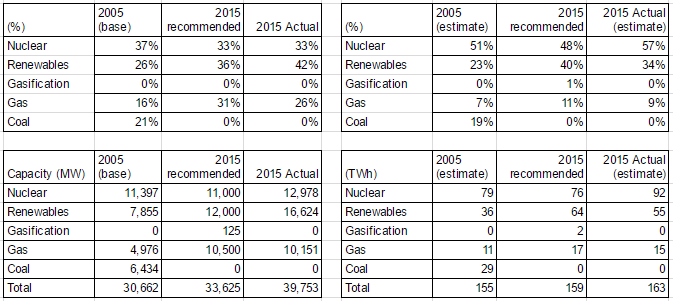

opa2005to2015actComp
Spreadsheet comparing OPA Supply Mix Advice from 2005 to estimated actual 2015 data.
1st posted in Reviewing a 2005 plan for Ontario’s electricity supply in 2015
19 days later, on September 18th 2008, a Minister of Energy and Infrastructure essentially killed 3 years of work with an unintelligible directive amending the 2006 Supply Mix directive.

Friday, April 27, 2012

Ontario replaces Independent: Weakly Electricity Sector Downgrades


I posted the latest weekly reporting figures this afternoon, and the data, fittingly, indicates a new record.  Week 16 is notable as the first week with Ontario demand growth over the previous year (Easter weekend was in 2011's week 16) - but the growth average for Ontario's demand was only 305MW/h, whereas the growth in net exports was 828MW/h.  The increase in net exports, combined with pricing remaining a third lower than in 2011, caused the export subsidies, by my estimation, to surge to record levels - for the third week in a row.

The Canadian Press shared this important bit of news this week:
TORONTO - Energy Minister Chris Bentley hasn't abandoned the idea of having a "real name" for the merger of the Ontario Power Authority and the Independent Electricity System Operator after all.
Bentley complained the energy sector is full of agencies known by acronyms like the OPA and IESO when he announced the planned merger of the two electricity planning agencies.
The minister said at the time he wanted the new agency to have a real name, but in legislation introduced today, it is known as the Ontario Electricity System Operator, or OESO.
In rearranging the Ontario Power Authority and the Independent Electricity System Operator,  Minister Bentley kept on 4 of the words: Ontario Electricity System Operator (OESO) is the working title.

Independent
Power
Authority

These words the Minister extinguished.

Sunday, March 4, 2012

Class A Absurdity

My previous blog entry described the government's creation of a separate class of customer, which I put in the context of the need to get electricity pricing for industry competitive with other jurisdictions. I carefully referred to that methodology as 'absurd.' Today a review of why it is absurd, why it is bad that it is absurd, and why Ontario is worse off because absurd is tolerable in our electricity system.

The creation of the Class A customer, one with "average monthly peak demand in excess of 5 MW," and the methodology for setting their rates - " the five hours, occurring on different days, in which the greatest number of Megawatts (MW) of electricity were withdrawn by all market participants" - are set out in the Environmental Registry entry for the change to the global adjustment mechanism:  
The proposed changes to the global adjustment mechanism would provide large consumers with a strong incentive to reduce consumption at critical times, consistent with the government’s commitment to creating a culture of conservation. By reducing peak demand, the proposal is expected to avoid costly investments in new peaking generation resources and imports of electricity from jurisdictions reliant on coal-fired generation.
Absurdity #1:  There is an Environmental Registry entry for the change (greenwashing).

Tuesday, January 17, 2012

A Sober look at Ontario’s 2011 Electricity Figures

"He uses statistics as a drunken man uses lamp-posts...for support rather than illumination."
                                    -Andrew Lang (1844-1912) Scottish poet, novelist and literary critic


Ontario’s Independent Electricity System Operator (IESO) issued a news release on January 6th titled,“Composition of Ontario’s Electricity Supply Mix Continues to Change: Consumer Response Supports Reliability.” The introduction posits there were three trends highlighted in the data; “increasing production from renewable resources, reduced dependence on coal-fired units, and a more active role for consumers in managing their consumption.”   Not exactly the 3 trends I'd look for
  • The 'customers' most active in curtailing peak demand are businesses, as Parker Gallant and I demonstrated in a recent article. Many of them pitch in by closing up altogether;
  • Use of coal-fired generation is reduced because the periods we need it are down, but at peak demand we relied on coal-fired generation (I wrote on that here);
  • There is no trend to increasing production from renewables in the IESO data.
There is a brief uptick. From only the data presented by the IESO, summing up hydro and wind the numbers go from 39.7 TWh in 2008 to 40.4TWh in 2009, 33.5TWh in 2010, and then we have a singular point as an uptick in 2011, to 37.2TWh. While up on a dry 2010, the total renewables figure is unimpressive against a longer trend. In the past 22 years, renewables have infrequently produced less output than in 2011.

Monday, December 12, 2011

Secret Deals between Public Power in Ontario and Quebec


There have long been suspicions that Ontario has been dumping hydroelectric production.    Earlier this year a report  indicated Americans were generating power with the Ontario water allocation we were unable to use.  As the year progressed and water levels of the great lakes remained well above 2010 levels, it became apparent that Ontario’s hydro levels were producing at new lows as the year progressed.  I reviewed generation figures by site for September, and noted a big drop in the output from the unregulated segment of the Ontario Power Generation (OPG)  Ottawa/St. Lawrence Plant Group .  I made inquiries as to whether the water sharing agreements from the Niagara River were mirrored for rivers shared with Quebec at the time, which went unanswered.  Now I believe I’ve stumbled upon the proof that we have agreements with Quebec resulting in exports, and generation, that are not being reported.

Monday, November 14, 2011

More Wind Records For Ontario - Emissions Rise

Sunday November 13th saw record electricity production from Ontario's wind turbines.   No coal-fired generation was replaced, and emissions from electricity generation in Ontario increased over the comparable day from the previous year.


The initial IESO data shows 32,401MWh of generation this past Sunday, which would be a record. (endnote 1).
Hour 9 has 1426MW recorded, which is the highest hourly figure recorded.

Friday, November 11, 2011

Reviewing Ontario's Feed-In Tariff: Part 1

The Ontario government's announcement of a review of the Feed-In Tariff (FiT) program raised alarms among observer's of Ontario's electricity system.  The review has been put in the hands of a senior bureaucrat from outside of the electricity planning process, de-emphasizing knowledge of Ontario's electricity system..  The government developed a survey and wrote; "All Ontarians are invited to participate in the review of the FIT Program and can provide feedback by answering an online survey or making a written submission at 2yearFITreview@ontario.ca."    The government claims their review will "examine program rules and pricing to ensure the program remains successful and sustainable."  
Remains 'successful and sustainable'?
That is a disconcerting description, but the distortion seems even more bizarre in the official government survey.  Surely in order to comment on revisions to the plan, we should review the first two years to evaluate the accomplishments of the program thus far.  This is especially true as the first accomplishment was to halt comprehensive long-term planning of Ontario's electricity system

Wednesday, June 22, 2011

May 2011 Ontario Electricity Rate Soars

The Independent Electricity System Operator (IESO) has released the Monthly Market Report for May 2011, and it confirms the message of rapid price inflation for Ontario's business sector.

The Commodity Charge for the businesses/industries subject to the wholesale rate soared to $75.94/MWh, driven primarily by a Global Adjustment charge of $50.05/MWh. That is a 17% increase over May 2010's $64.73.

The total rate of $98.90, including delivery and all other charges, was only 14% higher than one year earlier. That's as close as businesses can expect to get to good news as a glutenous Ontario Power Authority continues to contract additional, and extraordinarily expensive, supply - despite the oversupply we so clearly have.

May 2011 Ontario consumption dropped 5% from the same period in 2010.


Thursday, February 24, 2011

Wind Swirling In Their Heads

Today, the Ontario government announced another round of winners in Ontario Power Authority’s FIT sweepstakes.  Next week the Independent Electricity System Operator (IESO) has meetings to develop the infrastructure to facilitate paying the FIT sweepstakes winners not to produce any output. 

Thursday, February 17, 2011

Ontario’s Government’s Final Act in Electricity System Planning Farce

Less than one week after saying there wasn’t enough research to proceed with off-shore wind, reinstating the moratorium lifted 2 years ago, and returning to a time when there wasn’t enough research, the government issued a release today stating ”Long-Term Energy Plan Takes Another Step Forward.”    The off-shore wind is now simply planned for on-shore - most probably very near the shores of Erie, Huron, and, Pickle Lake.

Monday, February 7, 2011

Environmental Attributes For Sale: Desperate Times Call For Desparate Measures

The Financial Post has a short note today on the latest whimsy at the Ontario Power Authority (OPA) - selling Environmental Attributes.

Shortly after the closing of North America's only carbon trading market, The Chicago Climate Exchange, the Financial Post cites a bulletin from Borden Ladner Gervais LLP’s (BLG) Climate Change Group, who seem perplexed as to why this would happen now - and what the 'this' is?

There shouldn't be a lot of surprise.  It's been almost 2 decades since Maurice Strong's Ontario Hydro tried to account for environment factors through implementation of a Full Cost Accounting process, and a couple of years since the OPA went from a small group of system planners to be 20-30 times larger as it became obsessed with the negawatt while writing contracts that pay private electricity suppliers about $2 billion a year more than the market would (the GA-OPA component of the Global Adjustment).

Wednesday, January 12, 2011

Much To Do About Nothing: Electricity Policy In Ontario


Something is bad.
Nothing is not.

This was a revelation for me. Nothing is what we all work towards. In the Ontario electricity industry of 2011, nothing drives everything. There are a number of laggards who fail to see the importance of nothing so, politically, the industry has adapted. There are ways to boast of doing nothing – generally by a flurry of feigned activity supported by measuring nought.
3 or 4 years ago I saw the long-term trend in Ontario Electricity consumption, from the Conservation Bureau. That was another revelation for me.