Showing posts with label Politics - Ontario. Show all posts

Sunday, May 3, 2020

Consequences of Ontario's Green Energy Act warn against creating green new deals as stimulus

As economic activity takes a seat way back from the driving priority of halting the spread of COVID-19, recession is looming, and proposals popping up for spending to spur recovery. People, particularly those in Ontario, should be informed on the actions to spur stimulus during the last big recession, for two big reasons. This post will concentrate on the first - which is the cost, and benefits, of the actions initiated by the Green Energy and Economy Act of 2009.  I'll tally up costs incurred due to the electricity procurement than followed, and note the impact on post recession Ontario in quickly noting how those costs have been getting paid - and then I'll conclude with the second reason people need to know this history and its current impacts.

The Green Energy and Green Economy Act (GEA) was introduced to the legislature early in 2009, and received Royal Assent 3 months later. It provided the basis for a contracting orgy that persisted until the fall of 2011 before slowing to occasional carnal encounters. The impetus of the "green energy" push was a waning economy, as described by Karen Howlett and Renata D'Aliesio in 2011:
[Ontario Premier Dalton] McGuinty began looking at where to place his strategic bets during the global economic recession in 2008, when manufacturing jobs were quickly vanishing in Ontario. He solicited many opinions, said a source close to the talks, and the jurisdiction that kept coming up was Germany.
Mr. McGuinty turned to David Suzuki, Canada's best-known environmentalist, to set up a meeting with the father of Germany's green energy revolution, Hermann Scheer, in June of that year. The German parliamentarian arrived in Mr. McGuinty's office in the Ontario Legislature with a blueprint for building a new economy from scratch.
The McGuinty government heeded the now-late Dr. Scheer's advice. George Smitherman, then the new energy minister, adopted the "feed-in tariff" model that Germany used to become the world's first major renewable energy economy, committing to pay above-market prices for green power.
Liberal MPPs learned about their government's push into green energy in the fall of 2008 during a caucus retreat at the Benmiller Inn in Goderich, where Mr. Smitherman talked about the potential to create 50,000 jobs...
Ontario's green energy procurement were far from Keynesian economics. Instead of government borrowing to invest in the infrastructure that would aid productivity and grow wealth in the future, the government avoided borrowing by attracting private capital by offering generous contract terms trusting its existing global adjustment mechanism would allow the costs to be paid by electricity ratepayers. My understanding of economic theory is deficit spending on infrastructure during bad times allows for productivity to jump when better times return - but the GEA's contracting avoided growing government debt in return for making electricity more expensive in better times.
The Government of Ontario is committed to fostering the growth of renewable energy projects, which use cleaner sources of energy, and to removing barriers to and promoting opportunities for renewable energy projects and to promoting a green economy.
...
The Government of Ontario is committed to promoting and expanding energy conservation by all Ontarians and to encouraging all Ontarians to use energy efficiently. -Preamble to Bill 150 2009
The obvious costs from the GEA period are due to contracts awarded under the feed-in-tariff (FIT) program and related Green Energy Investment Agreement (GEIA) - better known as the "Sumsung deal". Less well known are the Hydroelectric Contract initiative (HCI) and Hydroelectric Energy Supply Agreements (HESA). Another stated goal of the Green Energy was the promotion of a 'culture of conservation' - with 'energy efficiency' and 'demand management' prominent phrases being joyously bandied about in and about the legislation. I've pulled the figures for those contracts, and conservation spending, from my database of estimates:


Saturday, March 23, 2019

Ontario government takes action to reduce electricity costs

Ontario's Minister of Energy, Northern Development and Mines (a.k.a. Energy) announced actions addressing electricity sector costs on Thursday. I summarized points from viewing the Minister announce the changes on Twitter:
  1. moving conservation cost from ratepayers to taxpayers is moving costs - not reducing costs;
  2. reforming the [Ontario Energy Board] is nice, but regulatory costs are neither a big portion of bills nor what drove rate increases;
  3. showing cost of [un]Fair Hydro Plan is also a positive - but also doesn't address costs.
While I was initially underwhelmed by the changes described by the Minister, having now reviewed the extensive material posted due to yesterday's announced changes I need to correct the misinformation I posted, and be more appreciative of some of the other changes.  

The main news release is titled, Ford Government Taking Bold Action to Fix Hydro Mess, and it shows I misinterpreted action on conservation as simply moving costs from ratepayers to taxpayers:
Find savings of up to $442 million by refocusing and uploading electricity conservation programs to the Independent Electricity System Operator (IESO)
The savings referred to are either efficiencies, in uploading programs from local distribution companies (LDC's) to the system operator (IESO), or program revisions. This is much clearer in reading a Ministerial Directives delivered to the IESO

Sunday, June 17, 2018

Ontario Electricity: Backgrounder and suggestions for Premier Ford

Ontario has a new Premier. Congratulations to Doug Ford who, despite my recent quiet, is receiving a lot of free advice on addressing costs in Ontario's electricity. Some of it good, but much of it not only bad, but based on flawed views of how Ontario's residential and small business consumers came to experience rapid rate growth.[2] I also have noted some advice - from academics - is oblivious to the new political reality of Ontario. Before getting into thoughts on controlling electricity costs, I'll provide my perspective on the politics of the situations that will determine which suggestions are actionable.

I wrote very little in the run-up to the election because it struck me as a race to the bottom. I used to write on things that angered me (to some extent), and then I'd hope to edit out my annoyance based on, "Nobody cares that I'm angry. What is my point?" This election the point seemed to be people were beyond angry with Kathleen Wynne. I'd call it disgusted. There's a saying in politics that "anger is not sustainable." That's probably true but around the time her government was introducing the ridiculous [un]Fair Hydro Plan I'd wondered if the Wynne policy team had let the anger of the first half of her mandate develop into disgust. Disgust is not an emotion, it's a sense. I was curious to see if I was wrong, and a climb up in the polls was possible for Premier Wynne. I don't think I was wrong - I do think the election was about this sense of disgust, and I found it so unpleasant I voted in the first hour of advanced polling and then tried to ignore it altogether.

I realize many of the angriest were people who follow my blog and know about the Liberal party's enormously wasteful performance in the electricity sector. The waste cost most Ontarians money, but not food, or housing, or heating. With the election over, and the previous governing party embarrassed by failing to win enough seats for official party status, I am hoping many will start the new era of Ford's rule by editing out their anger and trying to find their point. This is not a kumbaya moment though. A real cost reduction of the scope promised by incoming Premier Ford will require tough choices harming real people and angering numerous constituencies, but particularly the one known in the electricity sector as "stakeholders."

Political Constraints

The political reality of the election is pricing carbon is dead: Doug Ford took the leadership in the race for leading the Progressive Conservatives by opposing the recently implemented current cap-and-trade system in Ontario and the federal government's demand province's implement some regime. I'll try to avoid the topic - and fail (but hopefully only once).

Functional Constraints

Ontario's electricity, if mine is any indication, is pretty reliable (the lights stay on) and it is exceptionally clean, with very low emissions of greenhouse gases. My views on what can be done to control costs is influenced by two concerns that I don't see noted very often:
  • capacity
  • industrial electricity costs

Thursday, March 1, 2018

Review of 2017 electricity supply in Ontario

You purchase a  full 9-unit container of energy .
The 3 men who deliver it pour out 2 units out while lecturing on consumption. 
They imply you should make more yourself as they leave.

A couple of months have passed since I last posted to the blog. This may be due to writer's block, or a lack of ambition - or maybe I was wisely waiting until I had something nice to say!

With growing knowledge, and curiosity, I seem to muddle all little issues into the broad themes I deem important - and not only for energy. In this post I'll touch on metrics from 2017 the reader may be looking to this blog to find, with hopes of connecting the data to bigger issues.

There are many possible headlines from an annual analysis:
  • electricity "demand", as reported by the system operator was down, to levels not seen in decades
  • supply generated from fossil fuels (natural gas) was sharply down too, and again to levels probably not seen in over over half a century
  • prices for consumers on regulated price plans were sharply down in 2017 due to legislation and consequent debt (the [un]Fair Power Plan), but,
  • total costs for supply declined in 2017, although average unit cost was up slightly (as demand declined more)
  • nuclear supply was down as one unit (Darlington 2) was out of service for the entire year due to refurbishment, but the units remaining online largely took up the slack as Bruce Power had record output, as did the set of 9 units at Ontario Power Generation which operated during 2017, and
  • for the first year since the system operator reported on their system's wind output, in 2006, it reported a decline (albeit a very slight one)
I didn't wish to dwell on numbers in this post. During 2017 I learned some new data reporting tools which I put on on a site where I invite data-gluttons to learn the filters and views to generate the typical year-end summary statistics, such as the total annual biomass generation for the past decade.
I do wish, in this post, to combine commentary to statistics to demonstrate very good figures from one perspective can have bad implications from a broader perspective. This is particularly important to note as the reasons rates didn't rise sharply in 2017 aren't sustainable.

Friday, November 17, 2017

A benefit of Electricity trade - and what's reducing it

I was wrong.

I've been broadcasting a couple of messages about Ontario's electricity exports: that only the IESO can accurately report on the revenues, and that exports at negative prices are not allowed under market rules. It now seems neither of those is correct. Not only can export revenues be calculated, the analysis of export volumes, and revenues over time reveals benefits of markets, and trade. It's not at all clear Ontario's electricity powers understand the benefits.

I was recently alerted to a claim that the export revenues could be calculated from Intertie Schedule and Realtime Market Price reports. If that sounds confusing it'll gets worse before I'll try to ease off the jargon. As the Intertie Flows reporting is hourly, and the Realtime Market Price reports in 5 minute intervals some data manipulation is required to match the data sets. The IESO has posted annual files (.csv) with values from each of these reports for 2010 through 2016. To dispatch with the technical talk in one confusing swoop, I'll simply note that averaging the "ENGY" rate by delivery hour for each control area in the Realtime Market Price reports, and multiplying that by the "OFFT" value in Intertie Flows report for the same control area does result in the annual figures the IESO has released either to the Office of the Auditor General or in response to Freedom of Information Requests.
I can now extend my work from a previous post to include 2016 data.


Having worked the data down to the hourly time-frame by control area I can additionally summarize revenues, and costs, by jurisdiction. The results have some important messages about trade - as each "control area" has a separate market control price.

I won't discuss imports much in this post because there's nothing new to discuss. Most imports into Ontario are now from Quebec (over 82% since 2012 began), and those are valued in the new analysis almost exactly as the typical Hourly Ontario Energy Price (HOEP) valued them.

Messages about trade from this analysis may be hidden by the realities of communicating summaries of very large data sets. I posted some graphics on hydro(electric) generation by river system, and I received an e-mail from somebody who likely wanted to pursue a story, asking if the data was public knowledge. It was every bit as much public knowledge as what I am writing on today - summarized from hourly data captured from IESO hourly reporting since 2010. However, as most can't process the hourly information, and an official source had not published a summary, it wasn't the basis of a story. I think publication of a summary by an official source is what is required to be considered "public available".

The IESO once summarized volumes and revenues for exports and imports on a web page at www.ieso.ca/imoweb/siteshared/imports_exports.asp (long since a dead link). These monthly totals were meaningfully publicly available as they were both available and summarized by a trusted figure. Remnants of the IESO summaries remains in old government press releases, such as this from May 2012:
"Ontario's electricity market generated over $20 million in April by exporting electricity to other states and provinces, bringing total net export revenues to over $75 million this year.
That figure was, in hindsight, actually net exports ($28.6 million revenue from exporting less $8.1 million importing cost). In 2012 I noted:
[my] figures on export sales are estimates based only on the [Hourly Ontario Energy Price] ... in actuality export customers pay different rates. Because Ontario's market pricing is lower, sometimes much lower, than adjacent jurisdictions, it appears from both the ministry 'news' releases, and National Energy Board reporting, we generally export power about 10% above the HOEP  rates.
10% was the assumption I had when the IESO ceased summary reporting, but with the base data now summarized, I now know that assumption became wrong as they moved up and up, to nearly 70% above HOEP valuations by 2016.


Sunday, October 15, 2017

A gathering in Prince Edward County

Today in Picton people will assemble at a rally against what has become a 9 turbine industrial wind development in a ecologically sensitive area near Lake Ontario. I won't be attending as it's a 3-4 hour drive away, but I will contribute by arguing the existence of the contract for the location, at this time, is indicative of negligence at Ontario electricity system operator (IESO).

Details at the Prince Edward County Field Naturalists Facebook page
This rally coincides with a legal action launched by the Association to Protect Prince Edward County (APPEC). 
APPEC has commenced legal proceedings naming the Independent Electricity Operator (IESO) and WPD White Pines Wind Inc. (WPD) as respondents. APPEC alleges that the Feed-In-Tariff (FIT) contract between the IESO and WPD should have been terminated as soon as it became evident that WPD would be unable or incapable of fulfilling the FIT contract terms. These FIT contract terms have been made publicly available and are well known.
In 2010, a FIT contract for 60MW wind energy project to be operational within three (3) years was offered by the Ontario Power Authority (now the IESO) to WPD. The contract allowed for termination if the project was not able to deliver at least 75% of the contracted power.  -APPEC (on Facebook)
The inability to deliver 75% of contracted capacity is but one of the reasons WPD cannot now fulfill their end of the feed-in tariff contract.

Tuesday, September 26, 2017

Global Adjustment mechanism again headed to court.

Jeff Zochodne reports that a,
August lawsuit filed by National Steel Car (NSC) believes the revenue the IESO collects for the global adjustment, from the company “and others,” should be declared “an unconstitutional tax, not a valid regulatory charge.”
The company gives numerous reasons, including that the global adjustment allegedly “redistributes wealth from the consumers of electricity in Ontario to, among others, the generators of renewable electricity.”
I don't like their chances, partially because I doubt the quality of Ontario's courts, but I will discuss reasons the lawsuit has a chance at succeeding to demonstrate the need for changes in Ontario's too pliable electricity pricing structures.:
  • pricing includes the full cost of current supply despite the intent of the Green Energy Act to grow value outside of Ontario's electricity sector, 
  • the courts have already ruled the global adjustment structure to be a subsidy of one group of consumers, at the expense of all others,
  • only certain consumers were exempted, at the end of 2015, from the Debt Retirement charge, and,
  • another group of consumers has now been rewarded with a "Fair Hydro Plan"
The global adjustment mechanism being challenged was introduced in 2005 to ensure the full costs of electricity supply were paid by consumers of electricity (Section 25.33 (1) of the Electricity Act 1998) - it was intended to be the difference between what suppliers were paid through contracts (or regulated prices) and what the market valued supply at. In half of the first 26 months of the global adjustment the line item was a credit on consumer bills, but it's been a charge in all but one month since 2008.

Monday, June 5, 2017

Ontario electricity: How we got to here

It is the best of times, it is the worst of times.

The best: over the first five months of 2017 the reporting from Ontario's system operator (the IESO) indicates less than 2 terawatt-hours (TWh) of electricity has been generated from natural gas fueled facilities, with the remainder of 59 TWh generated on the IESO system coming from near-zero greenhouse gas emission sources. Since April 2014 coal has not been burned to produce electricity in the province. Emissions intensity of generation over the first 5 months of 2017 is approximately 14 grams of CO2 equivalency per kilowatt-hour (g CO2 eq / kWh), which is particularly low for a jurisdiction receiving less than 30% of its generation from hydro-electric sources.

Some things will be viewed as good, or bad, depending on the perspective of the observer: the last two months demand of IESO supply has been lower than in any month since 1994. If "conservation" is good, it would seem Ontario has it good. Supply is plentiful. So plentiful the IESO reported 19 per cent of of "wind energy produced in the province" was dispatched down (curtailed) in 2016, and Ontario Power Generation (OPG) reported 16% more hydroelectric generation could have occurred if not for surplus supply. The numbers on the surplus in 2016 are noteworthy: 7.6 TWh curtailed equates with 5.5% of the 137 TWh "withdrawn from the high-voltage transmission system by Ontario loads", but a further 21.8 TWh was exported meaning total supply (including imports) was 21.5% more than those loads required.

Some things are now viewed as bad, that were previously viewed by some as good. Regulated Price Plans charging residential, farms and other small business consumers what the government had longed planned to have them paying are suddenly being cut steeply through a debt scheme to be paid off whenever down the line. In order to keep cost hikes in line with previous projections the government already had to abandon first the collection of a Debt Retirement Charge and then the provincial portion of the Harmonized Sales Tax - some feel the lower government revenues a negative.

I've written often on the causes of higher rates in Ontario. I am inspired to do so again by the uncovering of documentation from a previously hidden Integrated Power System Plan in 2011. Shawn-Patrick Stensil, of Greenpeace, acquired the documents through a long Freedom-of-Information (FOI) process.

This post examines 3 long-term plans' annual forecasts of Ontario's electricity supply mix, with a focus on the capacity mixes forecast for 2016 compared to the current actual supply composition.

The current situation is not accidental.

This is how we got to here

Wednesday, April 19, 2017

Ontario government acting like small manufacturers' bad boyfriend

We are tripling the size of the cut we're making to people's hydro bills from 8% to an average of 25%. - Ontario Premier Kathleen Wynne
On March 2nd the Premier of Ontario announced "Fair Hydro Plan" actions "cutting electricity bills by 25 per cent." The announced actions cut no actual costs. To the contrary, interest expenses are expected to climb to $1.4 billion annually, perhaps totaling $25 billion in the fullness of time. Perhaps $40 billion.

My two previous posts have looked at rate components from a residential bill perspective, and an overall system supply cost perspective. I hope I have communicated that rates have risen substantially due to one small set of recently contracted supply, while nuclear and hydro provided the bulk of supply but little of the cost increases - and that not all consumer groups shared the burden of the rate increases. In this post I'll review the politics of recent electricity pricing policy decisions.
"We feel that a lot of manufacturers are the middle child that are completely left out...They saw almost nothing in the recent announcements." 
Jocelyn Bamford - Coalition of Concerned Manufacturers
It's been over 6 weeks since the government announced it's so-called "Fair Hydro Plan", and while some details will remain sketchy until enabling legislation/regulation is introduced, the overall intent is clear. Ontario governments reacting to increases in electricity prices with rash programs to calm the populace are nothing new, but the current government's targeting of rate reductions is.
Graphic originally from Ontario’s perceived electricity cost inflation


Significant previous actions include the rate freeze introduced in the early 1990's by the NDP government headed by Bob Rae, and a rate freeze introduced a decade later by the Progressive Conservative (PC) government headed by Ernie Eves. An article from November 2002 puts into perspective the long duration of the rate freeze:

Wednesday, March 1, 2017

enough of experts: The End of the IESO

“I think people in this country have had enough of experts...
enough of experts from organisations with acronyms saying that they know what is best and getting it consistently wrong.”  -Michael Gove, June 3, 2016
Gove's "enough of experts" was one of 2016's most mocked phrases. Those considering themselves on the side of angels/experts ignored the nuance, but perhaps the public did not as Gove's side won the referendum to separate the United Kingdom from the European Union, and later in the year the ultimate establishment candidate failed to be elected President of the United States despite the obvious flaws of her opponent. When people stop to examine if they've had enough of experts from organizations with acronyms, like IESO, many discover they really have.

Perhaps the people have a point, and modern "so-called experts" are simply those who benefited from the current situation. As "the victors write the history", the profiteers win the title of "expert".

It has been an eventful few months for Ontario's electricity system mandarins.

On September 1st the IESO delivered an Ontario Planning Outlook (OPO) to a rookie Minister (of Energy) - a report they were directed to produce by the former, veteran, Minister of Energy. Surging electricity rates were considered the main issue in a by-election held the same day, in which the government lost a seat that had been a traditional stronghold.
Before September was over the government suspended its Large Renewable Energy procurement, justifying the decision with, "The IESO has has advised that Ontario will benefit from a robust supply of electricity over the coming decade to meet projected demand." 
Before November was over the novice Minister of Energy was sketching out themes for a long-term energy plan built upon market concepts the IESO frequently enunciates.

By the end of November the Premier had stood before her Liberal Party and referred to high electricity prices as "her mistake."

It's important to review what created the current situation in Ontario - as I've been doing on this blog - but it's also pertinent to ask "who" did this. An old saying implores commentary to "play the ball and not the player," but eventually everything is about people.

Tuesday, February 14, 2017

The failure of the global adjustment: a renewables story

I recently was asked about the cost of buying out one group of Ontario solar contracts. The microFIT (feed-in tariff) contract exposure I estimated at $3.9 billion. This is the eventual cost of all your neighbours' panels, but not the larger arrays, which I estimate will cost another $33.9 billion. Call it a $38 billion liability which matches the most famous liability in Ontario's electricity sector history: the $38 billion attributed to Ontario Hydro at dissolution in 1998 - liabilities attained in building almost all of the province's generation, its transmission infrastructure, and much of its distribution infrastructure.

The solar contracts that carry the $38 billion total will produce about 4.3 terawatt-hours (TWh) of electricity a year, which is roughly 3 percent of Ontario's demand.

This solar story is about the failure of the global adjustment mechanism.

Sunday, December 18, 2016

Reliable Electricity Generation Capacity declining in Ontario

Ontario's electricity sector provided some material worthy of commentary over the past week.

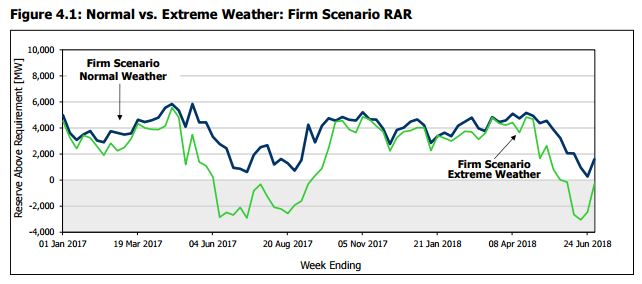
A new 18-month Outlook issued by the IESO (the province's system operator) begins cheerfully enough:
The outlook for the reliability of Ontario’s electricity system remains positive for the next 18 months, with adequate generation and transmission to supply Ontario’s demand under normal weather conditions.
This is reassuring - unless there's a particularly hot run of weather:
Under extreme weather conditions, the reserve is below the requirement for 19 weeks over the entire Outlook period, with the largest shortfall being approximately 3,000 MW.
19 weeks in 18 months is 24% of the time - corresponding with the quarter of the year known as summer. In a province introducing carbon pricing in January (poorly), apparently the government is unconcerned about local warming.

firmscenario

There has been similar language in previous 18-month outlooks:
During the Outlook period, the...forecasts show that Ontario’s available generation exceeds projected demands...there are periods when Ontario’s available reserves are forecast to be ...below the IMO’s required planning reserve levels.
That from the Outlook produced in April 2002.

I'm sure today's Wynne government finds comfort in how well Ontario's system coped with heat waves in 2002 and 2003 - despite their braying indicating the opposite.

Tuesday, November 22, 2016

something about electricity rates: the Premier's mistake

Premier Kathleen Wynne is calling high electricity prices her “mistake,” begins a report on her speech at the Ontario Liberal Party's annual general meeting. The statement would appear sincere if accompanied by an explanation of exactly what she thought her mistake was. As a political tactic, as I think it is, it's a good move in positioning the Liberal party for the election coming in 2018.
...a contrite Wynne told 850 Liberal delegates at the party’s annual general meeting here that her “government made a mistake” by allowing rates to soar.
“It was my mistake and I’m going to do my best to fix it,” she said...
Tactically, I think the move is based on two things:
  • the political rule that the electorate's anger is not sustainable
  • most expensive electricity contracts have now entered service and, combined with OPG's poor rate application, upward pressure on rates was, and is, planned to be less severe over the next couple of years.
These realities may allow the Premier to now position herself as responsive to people concerns. Adrian Morrow's report shows how she'd like to end up positioned for the 2018 campaign:
“I will do my very best to listen, to respond, to lead, and to serve you and the people of Ontario better,” she said. “I will be right there with you: As premier, as leader, I’ll be there with you as Kathleen, a proud mother and grandmother.”
These are the factors that put some wind in the sails of Wynne's Liberal ship. An article by Robert Benzie notes some of the content presented to the assembled Liberals by master strategist and Liberal campaign chief David Herle:
Even though [opposition leader] Brown publicly broke with social conservatives in August — saying he supports abortion rights, same-sex marriage, and the modernized health lesson plan — Herle’s findings suggest the Liberals plan to paint him as one.
Simply put, the Ontario Liberal Party is positioning the party for a culture war - with a caring grandmother running against a jerk.

It's a promising but risky tactic.

Saturday, July 23, 2016

The growing subsidy of wind and solar in Ontario

I was recently asked the amount of subsidies paid to wind and solar generators in Ontario, and felt answering deserved a blog post. I will show that from the introduction to Ontario's transmission grid of the first industrial wind turbines in 2006 up to June 30, 2016, subsidies to wind and solar generators have been approximately $6.4 billion.
More important than the figure, are the trends in annual magnitude and composition.

I have tried not to use the word "subsidy" in recent years - having been guilty of using poorly in the past. However, it's increasingly clear to me that avoiding the "subsidy" discussion has been harmful to Ontario's ratepayers.

In Ontario the word "subsidy" is often quantified by the amount paid for electricity by consumers above the price of that electricity in Ontario's market. The method of recovering that amount is the global adjustment mechanism. The complicated system with huge figures (on track to hit $12 billion in 2016) meant great attention was paid when the Auditor General of Ontario reported, "[from] 2006 to 2014, electricity consumers have already paid a total of $37 billion, and they are expected to pay another $133 billion in Global Adjustment fees from 2015 to 2032." 


However, with all generators in Ontario now recovering some of their costs outside of the market rate, the global adjustment has become a poor tool for defining subsidy. Treating the global adjustment as a subsidy ignores that Ontario's weak electricity market isn't intended to recover all the costs of generation. When the market functions to provide any indication of generator cost, it is usually only the fuel portion of a natural gas-fired generator's expenses. This makes the global adjustment a poor definition of a subsidy - although it's a fine indicator of the poor quality of Ontario's electricity market.

Monday, May 16, 2016

Waste Deep in the Nipigon

Ontario increasingly wastes electricity.

Wasting electricity is nothing new. I have a recurring earworm originating in a 1970's Ontario Hydro advertising campaign; "wasting electricity turns people off." In the decades since we are often reminded we use the wrong light bulb, the phone charger wrongly, water stupidly, and on and on. But today's waste includes actually curtailing emissions-free generation, without consumer savings, simply because there aren't consumers that can use the electricity. Much of that waste is avoiding generation from the public hydro-electric generation that gave the former  public utility the name "Ontario Hydro." Ontario Hydro is gone, but it's generators survive under Ontario Power Generation (OPG). I present OPG's generators on the Nipigon river as an example of the waste occurring in today's IESO administered electricity system.

The Nipigon river was in the news this winter as a new and unique, to the climate, cable-stayed bridge heaved, closing the TransCanada highway to all traffic for days, and requiring heaving loads to drive around Lake Superior for a much longer period. The bridge design was selected, at least in part, as it "eliminates the need for in-water structures in the Nipigon River."

15 kilometers (km) away, the Alexander Generating Station is an in-water structure that first started producing power in 1930. The current capacity is 69 megawatts (MW).

2 km upriver of that is the older Cameron Falls Generating Station, with a capacity of 92 MW.

OPG's Pine Portage Generating Station
17 km upriver of that is the newest, and largest of OPG's Nipigon River system generators, the 144 MW capacity Pine Portage Generating Station. A substantial reservoir exists behind Pine Portage:
Forgan Lake, south of Lake Nipigon, was created when Pine Portage was built. Forgan Lake was named by a decision of the Canadian Board of Geographic names on November 3, 1949. The lake comprises Hannah Lake and Creek, Eva Lake, Pine Point, Devil Rapids, Victoria Rapids, Emma Lake and others.
Conceptually, the same water provides electrical power 3 times, with it's journey through all three generators controlled at Pine Portage.

I've been tracking hourly generation reported by the IESO since September 2010.[1] To eliminate the typical monthly variations over the course of a year, I've graphed the moving 12-month total of each of OPG's 3 Nipigon River generators:


The decline of production at the Pine Portage generating station is obvious, and so dramatic in recent months I asked OPG on twitter if they, "would like to comment on reduced production at Pine Portage GS before I speculate." OPG responded, "Pine Portage GS is available to run if required. Suggest you contact @IESO_Tweets for demand information."

Friday, October 16, 2015

Wynne deserves no credit for dumbly selling Hydro One

Most of Ontario realizes they are losing a valued asset in the government's sale of a majority stake of the publicly owned Hydro One. The topic is so complicated most just don't realize exactly how they are losing, making it equally difficult to determine who is winning

Ontario's Premier outsourced evaluating the optimal use of public assets to an unelected council led by former retail banker and Bay Street titan Ed Clark. Clark's council reported, in April:
...the integrated Hydro One transmission and distribution business would likely command a fully distributed equity valuation of between $13.5 billion and $15 billion in a public offering, excluding Hydro One Brampton. We believe this valuation is a conservative range in the context of today’s market.
In the spring Clark envisioned $9 billion of cash from a share sale (60% of $15 billion), "with $5 billion going to pay the utility's debt and $4 billion being channelled into infrastructure projects."

The revised prospectus came out last week anticipating a share offer at $19 and $21- making the value of Hydro One's 595 million common shares $11.3 -$12.5 billion - but this valuation comes only after the government gives $2.6 billion to Hydro One, and Hydro One gives the government $800 million. [1] Adjusted for cash exchanges prior to the closing of the deal:
  • the valuation of Hydro One is more realistically $9.5-$10.7 billion
  • the valuation of the 60% of the company to be sold is therefore $5.7 to $6.4 billion
The revenue from the sale of Hydro One is anticipated to be positive for the provincial balance sheet, but not significantly. The government's 2014-15 Financial Statement carried Hydro One as an $8.072 billion asset, so selling off 60% requires writing down the asset $4.84 billion dollars. On the balance sheet the share sale is anticipated to have a benefit of $800 million to $1.6 billion.
“We are going to be able to track the projects that we are building. People are going to be able to look at how much money is coming in and where that money is being spent.”   Premier Kathleen Wynne
The Wynne government remains committed to spending $4 billion of the ~$6 billion share issue on transit, while using $5 billion (of the remaining $2 billion) to pay down debt. All from a transaction having a $1 billion impact on the government's $285 billion net debt - only enough for 34 days of payments on the province's existing debt.

There's a con here.

Wednesday, June 11, 2014

Ontario's next expense scandal: Endorsement and Condemnation

Tomorrow, Ontario votes to elect its next government.

It's been an interesting campaign for me, particularly because of some thoughts on the province's electoral politics I worked through writing on the last election, in 2011, and an ongoing interest in the relationship of numbers and narratives.

election results -
 as share of possible votes
My perception of provincial election campaigns are shaped by statistics on the share of possible votes (registered voters) achieved by parties. After 2011's election I began Lessons From Ontario's Record Low Election Turnout with:
One of Ontario’s 3 main political parties had a lower percentage of eligible voters opt for their party than had been the case since 1943.
That party won.

My premise has been that Ontario elections have been more about attracting voters, not moving the votes of voters from one candidate to another. This hasn't been true at the federal level, where the split in the Conservative movement returned successive majorities to the Liberal party, and it's not entirely true provincially, but the provincial conservatives should be able to win an election only by getting most of the people who vote Conservative federally to show up and do so provincially.

Tuesday, January 14, 2014

When is Tim Hudak not considered another Mike Harris?

Now we know when his constrant critics won't consider Tim Hudak to be another Mike Harris.

The Toronto Star provided opinion space for Tim Hudak to communicate that his PCs have a plan to bring prosperity to Ontario, and concurrently ran an editorial that began:
In order to maintain the prevailing theme of simplicity, let’s cut to the chase on Ontario Progressive Conservative leader Tim Hudak’s proposed “Million Jobs Act”: it’s campaign sloganeering, at best.
The Star's Queen's Park propagandist, Metro Martin Regg Cohn, took a stab at statistics in dismissing Hudak's plan by noting:
...Statistics Canada said Friday there were 588,000 people unemployed in the province. That’s a daunting number, but it’s rather less than the number Hudak claimed. He was off by about 400,000 jobs — that’s plus or minus 70 per cent — from the official tally.
Well, I empathize with communicators, and I will firmly support Hudak's party in 2014, so I was willing to cut him a lot of slack and not check to see if he was definitely rounding way, way up in the potential of any jobs plan.

But Metro Martin had concluded his column with a smug, "we're not stupid," so I figured in checking the possibility of adding 1 million jobs I might confirm 2 things.

Wednesday, July 17, 2013

Premier Wynne returns to work poorly

Yesterday Ontario Liberal Party leader, and therefore Ontario's Premier, returned from vacation to her role as Liberal leader.

Wynne, Justin T. and Ben Levin (since conficted of child porn charges)-source
During the week she was away there were a couple of incidents one might have expected the Premier to be around to address: 
  • a transformer station failed causing prolonged power supply problems in a transmission system that had been referred to, years ago, as, "the weakest of any major financial centre in North America and probably the weakest such centre in the OECD"
  • Benjamin Levin, the deputy minister that served in the Ministry of Education while Kathleen Wynne was the minister, a man who recently served on the transition team as she became Premier, and shared a stage with her at Toronto's recent Pride festivities, was charged with child porn offences
In her return to the public stage, the unofficial scribe of the Liberal Party of Ontario tells us:

Thursday, June 13, 2013

The Final Day of Dalton McGuinty, MPP

The end of this session marks an opportune time for me to bring to a close my service to the people of Ottawa South as their member of provincial parliament.
...
I leave politics with my idealism intact and a deep sense of gratitude for the opportunity to have served in public life
"Idealism?" wrote Martin Regg Cohn, provincial politics writer for the Toronto Star.

"This is the point at which we could be saying generous things about Dalton McGuinty" began the column from the Globe and Mail's Ontario politics columnist Adam Radwanski.

Well maybe ... if it's warranted by his performance measured against his promised performance.

Dalton McGuinty came to power in 2003.  He'd lost his first election leading the Liberal party (as most first-time leaders do) to an incumbent Premier, but in 2003 Mike Harris had retired and Ernie Eves had been hurt by, amongst other issues, electricity costs.   

During the provincial election of 1971, when I was a teenager, over 73% of eligible voters went to the polls.
Voter turnout hit historic in 2007, and 2011
Lessons From Ontario's Record Low Election Turnout
By the 1999 election, the turnout among eligible voters was little over 50%.
When barely half our population takes the time to exercise their most basic democratic right, when turnout among young people and new Canadians hardly hits one-third, real change is needed.
People have lost faith in their politicians and their institutions of government.
Disturbing as it is, it is not hard to understand why.
For decades we have watched our democratic institutions erode. And for the last eight years we have seen these trends accelerate dramatically under the Harris-Eves government.