Showing posts with label Wind Subsidy. Show all posts

Friday, June 23, 2017

Solar: Ontario's Base-Value Power

What is the generation source least valued by Ontario's electricity market in 2017?

That is the question I asked on twitter the other day. I know it's not the most serious format, it's a small sample size, and my running the poll means there will be selection bias in the responses. I did invite others with different views of the energy world to share it - but they did not.


I got some feedback that the question was unclear. While there are multitudes of factors impacting/corrupting the metric, this question is precise. The IESO allegedly operates Ontario's electricity market, they do publish summaries for hourly generation by fuel (xml format) and they do publish an Hourly Ontario Energy Price (.csv format).

The least valued "fuel" - or generation source - this year as the 22nd of June, is the lowest valued by a big margin, lying 29% below the next least valued.

The lease valued source is the source least expected to be the least valued.

The least valued source is solar.

Which shouldn't come as a surprise. 
I'll briefly review the theory, put Ontario's experience in a broader context, and finally cherry pick one day to examine. Cynics may be surprised the day is June 12th, which is the highest demand day of 2017.

Tuesday, February 14, 2017

The failure of the global adjustment: a renewables story

I recently was asked about the cost of buying out one group of Ontario solar contracts. The microFIT (feed-in tariff) contract exposure I estimated at $3.9 billion. This is the eventual cost of all your neighbours' panels, but not the larger arrays, which I estimate will cost another $33.9 billion. Call it a $38 billion liability which matches the most famous liability in Ontario's electricity sector history: the $38 billion attributed to Ontario Hydro at dissolution in 1998 - liabilities attained in building almost all of the province's generation, its transmission infrastructure, and much of its distribution infrastructure.

The solar contracts that carry the $38 billion total will produce about 4.3 terawatt-hours (TWh) of electricity a year, which is roughly 3 percent of Ontario's demand.

This solar story is about the failure of the global adjustment mechanism.

Wednesday, December 21, 2016

Historical ignorance: on energy losses in decadent Ontario


Accusations of losses on electricity exports, and government denial of the fact, is far from news, but the reappearance of the topic in Ontario's legislature demands it be reviewed anew.
Progressive Conservative Leader Patrick Brown says the province sold $9.4 million worth of excess electricity for just $144,000 on Nov. 10...
Brown says Ontario has "given away" $6 billion in surplus electricity since 2009 by selling it at a big loss...
Energy Minister Glenn Thibeault...says Ontario made $230 million in 2015 by selling excess electricity to neighbouring jurisdictions.
Thibeault says Ontario suffered through power shortages and brown outs when the Conservatives were last in power, and had to spend up to $500 million a year to buy electricity from its neighbours to keep the lights on.
   -the Canadian Press via ctvnews.ca
I wrote on the costs to Ontario ratepayers of cheap exports almost 6 years ago, in rebutting the same spin as the Minister delivered yesterday when presented by a previous Premier. Later, in 2013's Ways to estimate Ontario's losses on electricity exports I demonstrated multiple methods to quantify losses on exports. The estimates of losses vary by methodology and assumptions, but if methods are applied consistently all indicate increased costs to Ontario consumers from producing far more electricity than necessary to meet their demands .

I won't revisit all the arguments I've made in the past, but instead tailor a response to the rookie Minister's old denials, emphasizing how poorly he is prepared to undertake the task of developing a plan for the sector.

Friday, February 12, 2016

Eating wind: Carbon capped opportunity Part 2

Reading Rooftop coal: Carbon capped opportunity Part 1 will benefit readers of this post

There's a message being spread about Ontario that the expensive, but low carbon emission, electricity it produces will soon be worth big bucks due to the proposed Clean Power Plan in the United States - and trading of emissions. This was implied by one member of the Climate Action Group on television recently (I wrote on the program), and quickly expanded upon in into an article in The Toronto Star:
... the country’s power sector is prepping for a dramatic increase in U.S. demand for clean electricity.
Action on climate change is the reason — more specifically, U.S. President Barack Obama’s Clean Power Plan, which aims to slash carbon dioxide emissions from power plants by a third by 2030.
The plan is expected to triple the flow of Canadian electricity into Midwestern and northeastern border states, part of a broader U.S. effort to comply with the international climate obligations that 196 countries agreed to in Paris.
...
The North American Electric Reliability Corporation [NERC], which monitors and regulates grid stability in Canada and the U.S., estimated in a report last April that net Canadian electricity exports under the Clean Power Plan could grow three-fold between 2020 and 2030 as demand for renewable power grows in states such as Ohio, Michigan, New York and jurisdictions in New England.
Here we have the agreement from Paris and the U.S. Clean Power Plan discussed, so I'll briefly discuss each to communicate the value for Canada, and particularly Ontario, is limited - but an opportunity does exist.

The most relevant quote for the Paris deal comes from The New York Times' Coral Davenport back in August 2014:
...President Obama’s climate negotiators are devising what they call a “politically binding” deal that would “name and shame” countries into cutting their emissions.
...Countries would be legally required to enact domestic climate change policies — but would voluntarily pledge to specific levels of emissions cuts...
That "name and shame" strategy was advanced in Paris, primarily because the President lacked the ability to have Congress pass anything legally binding. Countries provide plans for reducing emissions, and if they don't achieve them they will be mocked by countries that are achieving their goals, should there be any.

The U.S. Clean Power Plan, if it gets enacted, will offer states a couple of methods to comply with individual emissions targets based on a subset of generators operating in the states in 2012 (I'd need to check in the volumes of text to confirm the base year) - the subset exclude generators without emissions in service prior to 2013 (most notably nuclear); it therefore basically includes almost exclusively emitting facilities.
States can target either emissions intensity, getting facilities to an average of ~20% below the intensity level of the 2012 base year (so replace coal with gas, of augment coal with wind, etc.), or they can just reduce their emissions by the requisite amount (it varies by state). Those sound the same, but the first option could actually see increased emissions. Illinois, for instance, could likely replace older nuclear units with natural gas generators and easily meet clean power plan targets by doing so.
Emissions reductions can come in state or not - by power purchase agreements with facilities outside of the state, or through the trading of cap space (such as through clean energy certificates).

How does this impact Ontario?
___

The North American Electric Reliability Corporation [NERC] reference in the Toronto Star article is probably Potential Reliability Impacts of EPA’s Proposed Clean Power Plan: Phase I, which does show a forecast where:
"Canada exports three times more power to the United States, mainly NPCC and MISO North."
NPCC is the Northeast Power Coordinating Council and it includes Canadian provinces/systems east of Manitoba as well as the New England and New York system operator areas (NYISO and ISONE).

The NPCC jurisdictions don't import much more juice in the NERC work:
graphically edited to most relevant data from NERC "Potential Reliability Impacts of EPA's Proposed Clean Power Plan
The "MW Interchanges No CPP" indicates, for Canada, net exports of 5,461 megawatts on average if the Clean Power Plan doesn't come into force, which works out to an annual total of about 48 terawatt-hours (TWh), and that is the average that actually occurred from 2012-2014. The best case (State level application of the Clean Power Plan) offers an export opportunity into New York and New England systems of another 691 megawatts on average, but that's little more than Ontario wasted in 2014 as generators reportedly curtailed an average of ~550 megawatts (by way of annual totals of 376 thousand MWh of wind, 1.2157 million MWh of nuclear and 3.2 million MWh of hydro-electric power). The NERC document that enthused Tyler Hamilton writing in the Star doesn't offer much hope for the U.S. northeast bailing Ontario out of its over-supply.

Monday, November 9, 2015

A line and the race for expensive Electricity

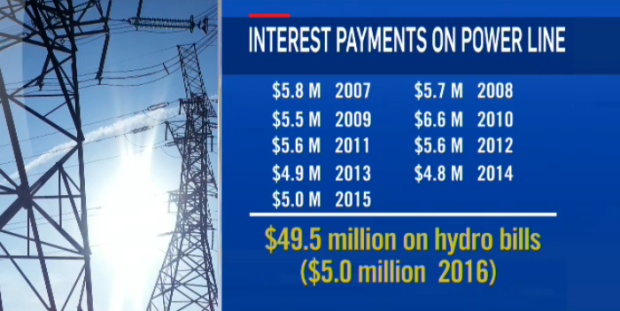
"Powerline to nowhere: $100M powerline costing taxpayers millions" was a provocative title for a CTV news story last week. The network reported their investigation indicated a transmission line without transmission wires wasn't transmissioning electricity, which didn't surprise me - what did surprise me is the video segment on the report implied "it had never been needed at all." The reality is far different than CTV's viewers would understand: the inability to "Install two new 230 kV circuits between Allanburg TS and Middleport TS" to "Increase import capability on Queenston Flow West," has cost many, many times more than the $50 million reported by CTV.[1]


The line was built to improve transmission to the Niagara area partly designed to complete in time to support increased capacity at the Beck generating stations of Ontario Power Generation (OPG). The completion of a $1.5 billion tunnel project  was to get more water to turbines, with an estimated increase in power generation of 1.6 terawatt-hours (TWh). The primary reason given by Hydro One, in 2005, for the "Niagara Reinforcement - Transmission Line Project was, "Facilitate new generation development in the Niagara Falls area." [2]

The need for that was apparent to all who read the Buffalo New in 2011, as it reported on the international agreement regulating the water usage from the Niagara river. Prior to the completion of the tunnel OPG was unable to utilize their full allotment of water for power generation and an agreement allowed the U.S. side to generate power with the unused quota.

Thursday, November 10, 2011

Hydro One 3rd Quarter Report Hints at High Costs Of Politicized Electricity System


Hydro One's Press Release on 3rd Quarter results includes a number of sentences that leave me scratching my head and wondering how much spending is necessary to keep the lights on, and how much should be attributed to the politically motivated connection of unreliable, heavily subsidized, generation.

Curiosity  seems to be in short supply these days, as the country's most read papers continue to print that bills can't have been going up due to renewables as most contracted capacity is not yet online.  They missed years of escalating delivery charges for Ontario's residential consumers.  I had previously looked at escalating capital costs (including the chart shown here, taken from an earlier article on our smart grid).  2010's capital expenditures finally leveled off, at 2009's level, but with the smart meter spending essentially completed, the recent Hydro One results don't indicate capital expenditures will be reduced.

Monday, October 3, 2011

Germany's Will to Power


“If someone declares publicly that nuclear power would be needed in the baseload because of fluctuating energy from wind or sun in the grid, he has either not understood how an electricity grid or a nuclear power plant operates, or he consciously lies to the public. Nuclear energy and renewable energies cannot be combined.”—Siegmar Gabriel, then-Federal Environment Minister of Germany

This quote was included in the anti-nuclear “World Nuclear Industry Status Report 2010-2011”, and it introduced two points: the first being that “overcapacity kills efficiency incentives,” and the second being that ‘renewables need flexible complementary capacity.’  The implication here is that because renewables need “flexible” capacity, and too much capacity isn’t desirable, inflexible nuclear baseload is undesirable.    If one buys into this premise, and if the question arises, “which is better,” a nuclear supporter is born.

That question doesn’t seem to come up very often.

Monday, June 13, 2011

Searching For Value in Ontario's Electricity System

I'm constantly amazed how difficult it is to underestimate the value of generation from industrial wind turbines.

I have queried hourly generation data by source 'fuels' to demonstrate the 'value' of the various sources. I was inspired to do so while writing my previous post, which calculated average hourly rates of imports/exports for different jurisdictions. Quebec was much more expensive power to import, but that was because we imported from Quebec at more expensive times. I concluded that was because Quebec could run off cheap imports at night to run as little water through the hydro turbines as possible, and run their hydro turbines during more expensive daytime periods for . Using the same process, with another data set, wind is demonstratively the least valuable source in Ontario.

Thursday, June 9, 2011

Smile, And Say "Goebbels" - A note from the government

This release, Electricity Exports Help Keep Ontario's Supply Strong,  is remarkably dishonest


"This revenue helps Ontario:
  • Keep costs down for families"
No, this revenue set against the costs of producing the power does not keep costs down for families.  This figure is meaningless by itself, and put together with the purchasing costs adds, by my calculations, $50 million to the costs of Ontario's consumers in the month of May only.  Net Exports (exports less imports) of over 1,300,000 MWh sold for only $3,100,000.

Monday, May 16, 2011

Price of Ontario's Electricity Policies Hits New High In April

The Global Adjustment rate for April is $43.89/MWh, which is the highest it has ever been. The reality of the mess we are in is being hidden by the mainstream press deflecting the blame from the government, such as Metro Martin's, “a small proportion of the recent hikes can be attributed to subsidies, for the simple reason that few renewable energy projects are up and running yet.” At The Globe and Mail, Adam Radwanski toned down the not-due-to government policy theme so trendy in the media hub of Toronto; “Mr. Hudak stands to capitalize on pocketbook angst over rising energy prices for which green projects have (to an exaggerated extent) been blamed.”


Exaggerated eh?

Tuesday, April 19, 2011

Wind Gluttony and Hydro Greed


Forbes has a report today on The Bonneville Power Administration (BPA), being forced to abandon plans to limit wind output in periods of extreme oversupply. 

I noted in a previous post a New York Times Blog entry that explained the BPA can't spill water to avoid generating power; “Water that goes over a spillway as opposed to through a turbine picks up bubbles of nitrogen gas from the atmosphere. When baby salmon absorb the bubbles, they experience something resembling the bends in a human diver.” In a display of sanity, the BPA stepped up monitoring and planning, including the regular display of balancing load, wind, hydro and thermal generation. The current snapshot is instructive; it shows huge exports made possible by enormous hydro supply, with a production trend that matches the load profile. Wind is used too, but the wind trend is balanced by thermal – as is the case everywhere wind has significant penetration.

Saturday, February 26, 2011

Sanity Advocates Policy Shift

John Spears is out with yet another article in the red Toronto Star, quoting, extensively, the Canadian Wind Energy Association's Robert Hornung.  “Wind advocate warns against policy shifts” again notes CANwea's Hornung claiming the low cost per kWh of wind is a cost effective alternative to other new supply possibilities.  It is per MWh, but in reality it doesn't replace any need for generation capacity.  It is simply a frivolous, expensive, extra that we have no need for.

Friday, February 18, 2011

Idiot Wind


I’m a Dylan fan that opposes the Ontario government’s plans for industrial wind turbines (IWT).  “Blowin’ in the wind” is not high on my list of favourite Dylan songs – I consider it his Kumbaya.  I’m weary, my Lord, of the constant references to ‘Blowin’ In The Wind” in stories in the press regarding IWT’s.   You only need two eyes to see the foolishness of that policy.  You only need two ears to hear about it.  I was glad the province quietly killed current plans for off-shore wind installations, at 19 cents/kWh, under cover provided by the news from Egypt on a Friday afternoon.  Unfortunately this news brings out the worst from the group thinkers struggling with math and analytics.   They earn a guttural, angry, response.