Showing posts with label Emissions (Pollution). Show all posts

Thursday, March 10, 2016

The cost of ending coal-fired generation, and renewables, in Ontario

Ontario stopped getting electricity from burning coal at the end of 2013. The coal exit is one element of Ontario's electricity system gathering attention from other jurisdictions, along with a very low greenhouse gas emissions intensity, the fastest growing (and possibly now the highest) rates in continental North America, and a high level of resistance to new generation from local residents. It might be logical for outsiders to associate the steep rise in the price of electricity as the cost of getting off coal, but that has not been the major factor pushing up rates.

Bruce Sharp, an energy analyst I greatly admire, recently produced Ontario Electricity - the Cost of Coal Replacement, which put some numbers up against an Ontario government document on The End of Coal. That document is not the proper starting point for evaluating the cost of ending coal, but Sharp's methodology for pricing provides a useful foundation to build an analysis upon.

table from Bruce Sharp's Ontario Electricity - the Cost of Coal Replacement

4,000 megawatts of wind, and 1,500 of solar, were not part of the plan to replace coal. I've previously demonstrated added natural gas and nuclear generators compensated for the removal of the coal-fired power plants.
Graphic from January 2013 post - data in this spreadsheet
Upon reflection, I think the proper starting point to evaluate the cost of exiting coal is June, 2005 - and it can include some wind. The elimination of coal was a 2002 recommendation of  an "all-party Select Committee on Alternative Fuel Sources", carried in the platforms of the three major parties into the 2003 election. That election was won by the party promising to eliminate coal by 2007 (not 2015 as the all party committee had recommended) - but they weren't succeeding in that goal, so in 2005 they released more specific plans described in this press release:

Thursday, March 15, 2012

The Lies of March: ENGO’s Coordinated Dishonesty Props up McGuinty


By the end of 2014, Ontario will be the first jurisdiction in the world to replace dirty coal-fired generation with more sustainable alternatives such as wind, solar and bioenergy -- the equivalent of taking seven million cars off the road. This is the single largest climate change initiative being undertaken in North America and will lead to savings of $4.4 billion a year in health care, environmental and financial costs.
-“Ontario Shutting Down Two More Coal Units” news release, December 1, 2011

This is one of the more recent quotes deliberately attributable to the Ontario government.  Most statements regarding coal have their foundation in a document from April 2005, “Cost Benefit Analysis: Replacing Ontario’s Coal-Fired Electricity Generation,” which was prepared by DSS Management consultants.  The quoted news release displays neither an understanding of the document, nor an attempt at understanding.  The figure above includes the energy based on 2004 generation and costs - if if were possible to replace 2004’s roughly 27.6TWh of coal generation with wind turbine output, contracted at $135/MWh, the cost would be $3.725 billion, plus the significant environmental and heath costs of that source.  There are no savings even if the report is accepted as gospel.

The figure people attempting honesty quote are found in Table I-4 of the report, and that figure is roughly $3 billion a year in ‘Health Damages.’

Wednesday, March 7, 2012

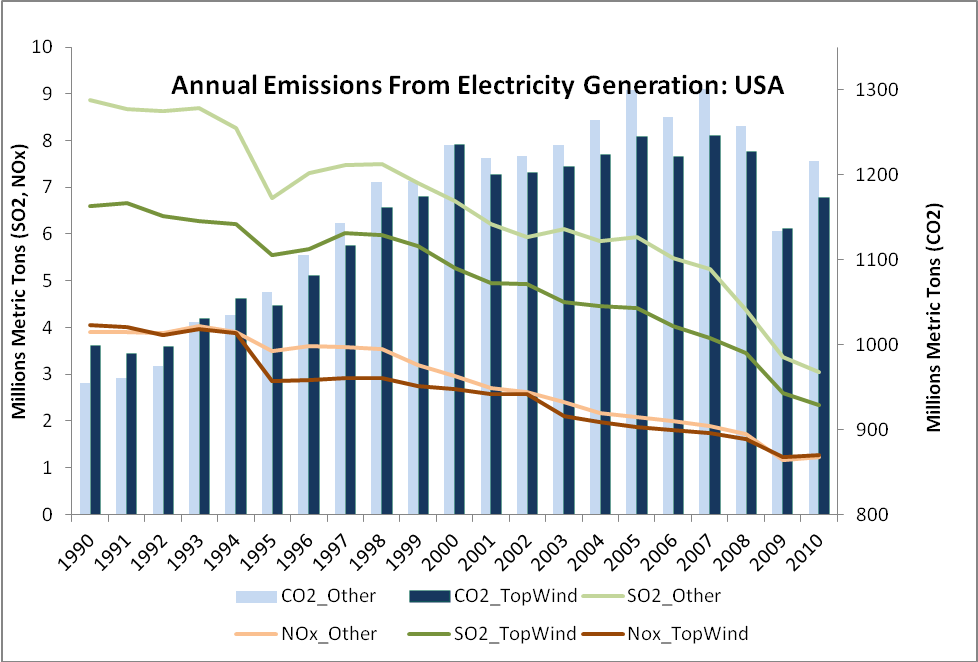
Wind Is Not Reducing Emissions

Top Wind States are the 20 states with over 930 GWh from wind, in 2010
Clearsky Advisors put out an article, a couple of months ago, built on US Energy Information Administration (EIA) data, comparing rate increases between 2005-2010, and total renewable energy capacity ‘of solar PV and wind.’ The same company put out a report in 2010 to claim spending huge sums on solar was great because it took all kinds of hours of work to create a Watt that way. That report went so well in 2011 the wind industry paid them to do the same. That report still gets trotted out by the ‘green’ lobby as proof of something or other whenever they wish to obfuscate - which, in Ontario (and BC and Alberta) they are doing this week to prevent rural governments from managing rural jurisdictions (only in Ontario).

Monday, August 8, 2011

A 400% Rise in the Global Adjustment, and Other Disturbing Trends


The Global Adjustment provides both adequate energy supply and green energy for Ontario. It accounts for differences between the market price and the rates paid to regulated and contracted generators and for conservation and demand management programs.


The IESO provided a second, lowered, estimate for July's Global Adjustment (GA), of $30.75/MWh or $390.3 million. In July 2010, the figures were $7.50/MWh and $98.8 million.

Thursday, July 14, 2011

The Fog Around Emissions From Electricity Generation

I've been mulling over tackling this topic since the ENGO's launched a campaign, to support the Green Energy Act and related FIT lotteries, built around implications of increasingly large heath costs due to the use of coal plants - despite a 90% reduction in the use of those coal plants. Recently there's been a great deal of news related to the points I thought were pertinent, the primary one being that if pollutants from electricity generation are decreasing, and respiratory problems are increasing, you should probably look at other urban issues,

Wednesday, April 27, 2011

Ontario's Electricity Secret Isn't Clean

The Toronto Sun had an editorial this morning on “Clean electricity’s dirty secret”.  It must have generated a buzz about the negative pricing, and dumping of hydro supply, because it was followed this afternoon with an article, by Antonella Artuso, which told us of the Premier’s responses to reporters’ questions regarding exporting power cheaply;  “McGuinty said he appreciates that many Ontarians struggle with his energy program — including the requirement that municipalities take wind turbines — but the goal is to bring green manufacturing jobs to the province and supply greenhouse gas-free electricity.”
If that is the goal, perhaps our Premier isn't getting great information from his underlings regarding his programs success. I've heard he's a real detail guy, so I've assembled some details to help out.

Wednesday, March 2, 2011

Reviewing EIA data: Lessons for Wind, Nuclear, and Reduced Production

I’ve been looking outside my little setting in the province in Ontario for data indicating signs of intelligent life in the electricity policy universe.  The U.S. Energy Information Administration (EIA) provides a wealth of data, and forecasts.  I’ve started working with a number of tables/spreadsheets for the period 1990-2009.   The first thing I checked was for the correlation between wind and emissions reduction – but that initiated some queries to uncover the best performing states in terms of reducing emissions, and that led to some others to find out what metrics did relate to reduction of emissions.   Most of the data I formulated compared 2009 to 1997[i].  I chose 1997 because it was the year the Kyoto Protocol was negotiated – the base year for that protocol is 1990, but I’ve learned that was a negotiated date long after it had passed.  After a lot of work, the conclusions from the data are things we knew 25 years ago.  Generating less energy reduces CO2 emissions – as does producing a greater share of electricity with nuclear.

Tuesday, December 7, 2010

Dim bulb in Ontario’s Highest Office

The Star has printed an editorial by their Premier.
Some rebutting is in order.

Mr. McGuinty was in the legislature prior to 2003. He is fully aware he is mostly making things up in his editorial. Between 2003 and 2005, Pickering 1, Pickering 4, Bruce 3 and Bruce 4 all came online – about 2600MW of nuclear production that had nothing to do with him. The generators were a stop gap plan alright – because the plan was already in motion and only required a stopgap temporarily.