Thursday, December 17, 2015

Losing time: everybody can't win Ontario's Electricity game

November's main electricity commodity rate in Ontario averaged $123.54/MWh, a full 10% higher than the previous record price. This post examines why.

Demand in November was very low, but almost identical to demand the previous month. The main electricity rate in Ontario is the Class B commodity rate comprised of the weighted Hourly Ontario Energy Price (HOEP) and the Class B global adjustment rate. It rose 23% from October to November. This makes a comparison of October and November very compelling.

The rate was the highest because data shows Ontario spent more on generation, and whatever else the system's operators felt related to generation, than any previous month.

There's been a lot of words about Ontario's electricity costs following the latest annual report from the Auditor General of Ontario, most from men in Ontario's electricity establishment claiming the female Auditor was unfair in noting the growth of the global adjustment. Today I am looking at the global adjustment only to estimate the total spend on electricity generation - and whatever else the system's mandarins feel is related to electricity generation - each month.


The graph's message is clear: total supply cost is rising. In November, Ontario spent more on electricity supply than ever before, despite demand levels near lows. Note the chart runs 49 months: November 2015 total supply cost is 53% higher than November 2011, while "Ontario Demand", as defined by the IESO, is down.[1] I don't want to dismiss the fact the price increase is seen entirely as a rise in the global adjustment, as that has very important cost implications in distributing system costs disproportionately across consumer segments. One result of growth entirely being in the global adjustment is the rise in the main, Class B, commodity rate is 77% over the 49 months - 24% higher than the increase in total systemic supply costs.

Why did the system's costs rise $240 million from October to November?

Wednesday, December 2, 2015

Don't believe happy presentations of Ontario's renewables pain

In January Ontario's government is introducing a new price support program to help poorer households with electricity costs. The planning for the program reveals an expectation that 1 in 10 Ontario households can not longer bear rising electricity rates.

I am inspired to write by two events of November 30th:
  1. Ontario's electricity system mandarins released an astronomical estimate indicating November rates will be 20% higher than ever before.
  2. CBC's flagship news program broadcast a poorly researched segment, "Canada's clean energy race."
Examining the Samsung numbers for high-priced November might provide a simple explanation of what the global adjustment is, but some background is necessary to judge the value Samsung has delivered.


Chris Brown's CBC report included segments interviewing Tim Smitheman, once a public servant, now an employee of Korea's Samsung further aiding that company in siphoning money out of Ontario. Brown celebrated Samsung, but any investigation would have revealed he could not have picked a better subject to display the failure of Ontario's green energy foibles.

A brief history lesson is necessary to communicate how poorly Samsung has performed for Ontario. In 2008-09, Minister of Energy George Smitherman and his boss Dalton McGuinty wanted to make a big splash to kick off the glorious renewables future German politicians and David Suzuki had convinced them was imminent. In January 2010 the government inked a deal with a Korean Consortium that included Korea's electricity experts, KEPCO (since departed the Consortium), and Samsung. The deal"would see the consortium receive preferential treatment from the province, in the form of priority access to the energy grid and higher-than-market rates for the renewable energy it creates as part of Ontario’s new feed-in-tariff (FIT) program." 
“It’s now a race to see which clean technologies will dominate, and wind and solar are off to a strong start” - Chris Brown, CBC, November 30, 2015
The Samsung deal has been a disaster. Hopes that expertise in LCD displays would lead to breakthroughs in solar panel manufacturing tech Samsung would base in Toronto disappeared, as did hopes expertise in shipbuilding would translate to breakthroughs in wind turbine design to be based in Ontario.
All those things were sub-contracted out.

Tuesday, November 17, 2015

New report numbers the IESO days, shows wind impacting Ontario rates

A new report on Ontario's daily electricity sector demonstrates the shortcoming of reporting of the sector's costs that contributes to the poverty of intellect in much too common communication on the sector.

The new report is from me, and it is to provide consumers, and other critics, with a more intelligent summary than the little noticed "Daily Market Summary" produced by the province's system operator (IESO). I hope some readers will work through the additional numbers as they can demonstrate the broad themes driving pricing in Ontario - and if some that do the work join a chorus calling for some transparency and meaningful reporting from the IESO,  my work in creating the reporting will be somewhat justified.

If one were to have no other information than the IESO Daily Market Summary reports for November 10th, and 12th, they'd think a little less demand - 187 megawatt-hours (MWh) - resulted in the price dropping $27.59/MWh to essentially free.

Ontario's demand for electricity did not change. The IESO's "demand" is not Ontario's consumption, but the demand for supply from generators in the IESO's market.

There are qualitative issues with the IESO report.
The HOEP price is the Hourly Ontario Energy Price. The weighted average is arrived at using hourly "Ontario Demand" and hourly HOEP - if one wanted to competently establish the "Value of Market Demand" they would not do it as the IESO does in this report. The weighted average price of exports has always been different, but since the IESO prohibited negative-priced exports the difference can be enormous.

Beyond the qualitative issues with the IESO's report is the absence of any attempt at costing the procured supply (their "demand"). With the global adjustment mechanism driving prices, this renders the report essentially worthless

Monday, November 9, 2015

A line and the race for expensive Electricity

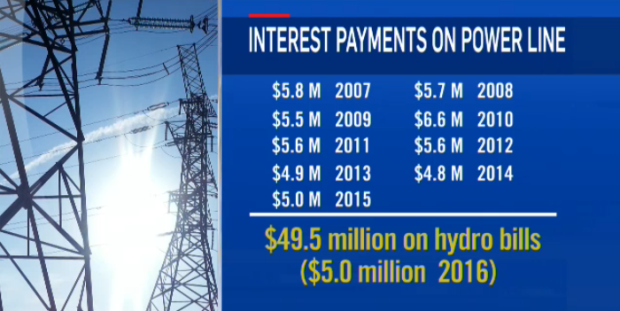
"Powerline to nowhere: $100M powerline costing taxpayers millions" was a provocative title for a CTV news story last week. The network reported their investigation indicated a transmission line without transmission wires wasn't transmissioning electricity, which didn't surprise me - what did surprise me is the video segment on the report implied "it had never been needed at all." The reality is far different than CTV's viewers would understand: the inability to "Install two new 230 kV circuits between Allanburg TS and Middleport TS" to "Increase import capability on Queenston Flow West," has cost many, many times more than the $50 million reported by CTV.[1]


The line was built to improve transmission to the Niagara area partly designed to complete in time to support increased capacity at the Beck generating stations of Ontario Power Generation (OPG). The completion of a $1.5 billion tunnel project  was to get more water to turbines, with an estimated increase in power generation of 1.6 terawatt-hours (TWh). The primary reason given by Hydro One, in 2005, for the "Niagara Reinforcement - Transmission Line Project was, "Facilitate new generation development in the Niagara Falls area." [2]

The need for that was apparent to all who read the Buffalo New in 2011, as it reported on the international agreement regulating the water usage from the Niagara river. Prior to the completion of the tunnel OPG was unable to utilize their full allotment of water for power generation and an agreement allowed the U.S. side to generate power with the unused quota.

Monday, November 2, 2015

October revealed flaws in Ontario's rate and electricity market designs

October 2015 provided a unique opportunity for analysis of Ontario's electricity supply system as the Darlington nuclear power station was unproductive due to a planned vacuum building outage. During the previous October Darlington generated 2.5 million megawatt-hours (MWh) of electricity, which was 23% of what the province consumed during the month. 2015's October therefore provides a glimpse of what Ontario's sector will be like in a few years, as the Clarington Transformer Station is completed and Pickering Nuclear Generating Station is closed.

Vacuum building outages are scheduled for the lowest demand periods of the year, and October is one of those month. October 2014 saw a glut of power and concluded with a $1+ billion estimate of the global adjustment (the difference between what the system pays suppliers and what is recovered through the sale of power at market prices). With the rise of solar (largely unreported in the province) Ontario regularly exceeded $900 million during the sunnier months of this year's second quarter, but 12 months ago $1 billion was a stunning, unprecedented number. Parker Gallant and I published an analysis of 2014's October noting:

  • the record high global adjustment total
  • the record global adjustment rate for the 90% of consumption that can be considered "Class B"
  • the record low Hourly Ontario Energy Price (HOEP) the market determined
  • the record low price for exports
  • the high level of curtailed generation (contracted supply the system could not take)
  • record supply from wind and solar generators.
Figure from IESO June 2015 18-Month Forecast
Ontario's system operator, the IESO, would include a graph of curtailments in June 2015 that showed Parker and I were close, if a little enthusiastic, in this claim:
During October, 2014, the IESO curtailed more than 500,000 MWh of production. While wind power accounted for 100,000 MWh directly, much curtailment at nuclear and non-utility generators (NUGs) and import cuts occurred due to bloated supply levels during periods of windy weather. If one combines the curtailed production with the exports for October, it is obvious that Ontario dumped more than 21% of the province’s procured (and paid-for) supply
October 2014 exports totaled 1.8 million MWh, dumped at an average price of about half of one cent per kilowatt-hour ($5/MWh). The 2.3 million MWh total, from exports sold at an enormous loss and supply simply curtailed, is only slightly off the 2.5 million MWh reduction in Darlington's production the following October. Ontario's demand was little changed from 2014's October to 2015's.[1]

It might surprise readers that much of Darlington's missing generation was replaced with generation from other sources, as exports dropped only 300 thousand MWh.

Friday, October 16, 2015

Wynne deserves no credit for dumbly selling Hydro One

Most of Ontario realizes they are losing a valued asset in the government's sale of a majority stake of the publicly owned Hydro One. The topic is so complicated most just don't realize exactly how they are losing, making it equally difficult to determine who is winning

Ontario's Premier outsourced evaluating the optimal use of public assets to an unelected council led by former retail banker and Bay Street titan Ed Clark. Clark's council reported, in April:
...the integrated Hydro One transmission and distribution business would likely command a fully distributed equity valuation of between $13.5 billion and $15 billion in a public offering, excluding Hydro One Brampton. We believe this valuation is a conservative range in the context of today’s market.
In the spring Clark envisioned $9 billion of cash from a share sale (60% of $15 billion), "with $5 billion going to pay the utility's debt and $4 billion being channelled into infrastructure projects."

The revised prospectus came out last week anticipating a share offer at $19 and $21- making the value of Hydro One's 595 million common shares $11.3 -$12.5 billion - but this valuation comes only after the government gives $2.6 billion to Hydro One, and Hydro One gives the government $800 million. [1] Adjusted for cash exchanges prior to the closing of the deal:
  • the valuation of Hydro One is more realistically $9.5-$10.7 billion
  • the valuation of the 60% of the company to be sold is therefore $5.7 to $6.4 billion
The revenue from the sale of Hydro One is anticipated to be positive for the provincial balance sheet, but not significantly. The government's 2014-15 Financial Statement carried Hydro One as an $8.072 billion asset, so selling off 60% requires writing down the asset $4.84 billion dollars. On the balance sheet the share sale is anticipated to have a benefit of $800 million to $1.6 billion.
“We are going to be able to track the projects that we are building. People are going to be able to look at how much money is coming in and where that money is being spent.”   Premier Kathleen Wynne
The Wynne government remains committed to spending $4 billion of the ~$6 billion share issue on transit, while using $5 billion (of the remaining $2 billion) to pay down debt. All from a transaction having a $1 billion impact on the government's $285 billion net debt - only enough for 34 days of payments on the province's existing debt.

There's a con here.

Tuesday, October 6, 2015

IESO reporting raising doubts about its ability to administer Global Adjustment charges

There are 5 hours every 12 months that determine the distribution of global adjustment charges in Ontario - charges of nearly $10 billion over the past 12 months. The 5 hours are particularly important for Ontario's largest consumers of electricity as cutting one megawatt of use during one of these hours has been estimated to save from $50,000 to $100,000 and more. In this post I'll explain why the hours for the adjustment period ending next April have likely already occurred, with some implications of peak hours for intelligent energy policy.
Background: "Stakeholders" destroying the viability of Ontario's electricity market
While the top 5 hours have already occurred the IESO is not communicating what they are. To understand why the IESO's communication of peak hours is inadequate, it's important to know the definitions of "Ontario Demand", "Allocated Quantity of Energy Withdrawn," and what I'll call "consumption."

  • The IESO's "Ontario Demand" is really demand from IESO transmission (Tx) connected suppliers, including imports. The figure does include generator consumption and transmission losses.
  • The supply withdrawn from that grid by local distribution companies (LDCs) and wholesale consumers, essentially comprises the "Allocated Quantity of Energy Withdrawn" (AQEW). The AQEW and "Ontario Demand" figures do not include generation from suppliers embedded in LDC grids (Dx): 
  • "Consumption" will be AQEW plus "the total volume of electricity, adjusted for losses as required by the Retail Settlement Code, that was supplied by embedded generators to licensed distributors." (Ontario Regulation 398/10)
High 5 hours are determined by AQEW, but the proportionate share of the global adjustment is determined by a Class A user's AQEW (their metered use) as a numerator with total provincial consumption as a denominator.

During an adjustment period the IESO lists only the 10 top daily "Ontario Demand" hours:


The fact that they show AQEW for those hours shouldn't be confused with showing the 10 highest daily AQEW peaks - because after the last adjustment period class A users were surprised to find 2 of the High 5 hours were never shown on IESO's "Top Ten" list as the year progressed.

Thursday, October 1, 2015

Wasting legacy asset value in Ontario: supply income redistribution due to the global adjustment


I regularly update data the drives pages on my data site. Pages on the site are meaningful to me because I recognize the changes over time - as well as seeing changes I anticipate become reality. Today I created a graphic from data that drives the Supply_Costs page, and will use this blog post to attempt to make the graphic meaningful for you.

When understood, this chart indicates numerous issues behind rate increases in Ontario - increases which hit a staggering 26% in the second quarter of 2015.