Thursday, June 23, 2016

The declining capacity value of solar in Ontario, and beyond

A solar panel added to Ontario, today, has a capacity value of less than 6% and the reality is if solar continues to be added peak requirement for new supply will move to winter evenings and instead of new solar’s capacity value being close to nothing it will be absolutely zero.
I wrote that yesterday and, inspired by an exchange on Facebook, want to support the statement, add industrial wind to it, and argue the relevance of the statement not only to Ontario, but in California where the claim is a nuclear power plant can be closed and the output replaced with negawatts/efficiency/conservation, solar and wind.

Electricity supply is of value to a system in multiple ways. The two I examine are basically the actual watt-hours of output (I'll call this "energy value", and the ability to produce the output when demand calls for it (this I will call the "capacity value"). 

The diminishing value energy value of intermittent generation should not be well known. I was excited to write on the decrease three years ago, but a current work from Lion Hirth (and Simon Müller) explains well why now seems obvious:
In hours of high wind speeds, the additional supply of electricity from wind turbines depresses the price below the level it would otherwise have been. This price drop is greater, of course, when larger amounts of wind power are installed, a phenomenon that has been described as the “self cannibalization effect” (a dramatic term for the simple consequence of increased supply). As a consequence, the market value of wind power declines with its market share.
This post will deal only with "capacity value".

Additional solar, and wind supply, have lower capacity value today because the operator of Ontario's electricity system, the IESO, released an updated outlook showing the capacity of solar panels connected to the IESO's system grew by 240 megawatts (MW) over the past 12 months, but the IESO expected only 14 MW of production from that capacity during the peak demand for generation. Dividing 14 by 240 gives a measurement for the capacity value, of 6%.

Less notably, but likewise moving lower, industrial wind turbine capacity increased 898 MW, with only 105 MW more output expected at peak demand. That's a capacity value of 10.4%, and as with solar, it's worth stressing those are the IESO's numbers, not mine. I'll address whether those figures are valid in a future post.

The reason for the decline is the expected hour of peak demand has moved later in a summer's day. The reason for the move is not a changing consumption patterns, but changes in the electricity supply mix. While this doesn't change the valuation story, it does require some explanation.

Monday, June 20, 2016

OPG's application to hike nuclear power rates harms credibility

The average cost of power from Darlington nuclear units post-refurbishment is estimated to range between $72/MWh and $81 MWh, or 7 and 8 cents per kilowatt hour.
So announced the Ontario government in a January 11th, 2016 news release.
137 days later Ontario Power Generation (OPG) filed an "Payment Amount for Prescribed Generation Facilities" application with the Ontario Energy Board, asking for rates for supply from its nuclear generators to rise to $99/MWh by 2021.
data from OPB_Exl1-1-1_Att1_OPG_RevenueRequirement Work Form_20160527.xlsx filed at OEB
I find the rate application disheartening.

Anti-nuclear forces will find it very useful.

Wholesale reporter Keith Leslie wrote of "a whopping 69 per cent increase...over the next five years" with quotes from his standard go-to Jack Gibbons, who just days earlier had an editorial in the Toronto Star arguing for the closure of the nuclear reactors at Pickering using some of the same arguments he had discredited 2 years ago (by me in June, and by the IESO/OPA in October), and some other sound-bite emotive appeals developed in the 1970's. [1]

Which doesn't mean Pickering shouldn't be closed.

Having a better record with OPG's financial arguments than they themselves do, I feel obliged to see if OPG's management was just inept in formulating a rate hike that I suspect more likely to scuttle the refurbishment of Darlington's reactors than extend the life of Pickering's, so I'll explore the production and revenue requirement totals with some historical context, and review the poorly chosen "smoothed" option.
This rate hike request reveals some things about what OPG has become, and also reveals shortcomings of the Ontario Energy Board (OEB) in regulating Ontario's electricity sector.

Monday, May 16, 2016

Waste Deep in the Nipigon

Ontario increasingly wastes electricity.

Wasting electricity is nothing new. I have a recurring earworm originating in a 1970's Ontario Hydro advertising campaign; "wasting electricity turns people off." In the decades since we are often reminded we use the wrong light bulb, the phone charger wrongly, water stupidly, and on and on. But today's waste includes actually curtailing emissions-free generation, without consumer savings, simply because there aren't consumers that can use the electricity. Much of that waste is avoiding generation from the public hydro-electric generation that gave the former  public utility the name "Ontario Hydro." Ontario Hydro is gone, but it's generators survive under Ontario Power Generation (OPG). I present OPG's generators on the Nipigon river as an example of the waste occurring in today's IESO administered electricity system.

The Nipigon river was in the news this winter as a new and unique, to the climate, cable-stayed bridge heaved, closing the TransCanada highway to all traffic for days, and requiring heaving loads to drive around Lake Superior for a much longer period. The bridge design was selected, at least in part, as it "eliminates the need for in-water structures in the Nipigon River."

15 kilometers (km) away, the Alexander Generating Station is an in-water structure that first started producing power in 1930. The current capacity is 69 megawatts (MW).

2 km upriver of that is the older Cameron Falls Generating Station, with a capacity of 92 MW.

OPG's Pine Portage Generating Station
17 km upriver of that is the newest, and largest of OPG's Nipigon River system generators, the 144 MW capacity Pine Portage Generating Station. A substantial reservoir exists behind Pine Portage:
Forgan Lake, south of Lake Nipigon, was created when Pine Portage was built. Forgan Lake was named by a decision of the Canadian Board of Geographic names on November 3, 1949. The lake comprises Hannah Lake and Creek, Eva Lake, Pine Point, Devil Rapids, Victoria Rapids, Emma Lake and others.
Conceptually, the same water provides electrical power 3 times, with it's journey through all three generators controlled at Pine Portage.

I've been tracking hourly generation reported by the IESO since September 2010.[1] To eliminate the typical monthly variations over the course of a year, I've graphed the moving 12-month total of each of OPG's 3 Nipigon River generators:


The decline of production at the Pine Portage generating station is obvious, and so dramatic in recent months I asked OPG on twitter if they, "would like to comment on reduced production at Pine Portage GS before I speculate." OPG responded, "Pine Portage GS is available to run if required. Suggest you contact @IESO_Tweets for demand information."

Tuesday, May 10, 2016

Ontario appeals court upholds sentence of higher costs for ratepayers

The Ontario Court of appeal recently upheld a ruling adding over half a billion dollars to Ontario's electricity bills.[1] The case involved a number of electricity generators contracted between 1989 and 1994 challenging a 2011 change in the method of calculating a benchmark to which payments are indexed. Officially the generators' challenge is against the Ontario Electricity Financial Corporation (OEFC). Functionally, it is ratepayers that were punished. How ratepayers came to be guilty is a legal matter, but the failure in court is a result of the failures of the province's recent governments.

The generators were contracted during periods of Liberal (David Peterson) and New Democratic Party (NDP) rule. Neither party was positive on the public electricity entity, Ontario Hydro, and its concentration on nuclear power. Ontario Hydro was forced by the governments to contract supply from "non-utility generators" - now simply called NUG's.

The court documents reveal a group of NUGs contracted with pricing indexed to "Direct Industrial Customers ...whose average monthly maximum demand was 5 MW or greater." An additional and pertinent specification in the indexed model is "a 100% load factor, meaning a constant and consistent energy demand for all 8760 hours of a year."[2] 

The court's ruling, upheld on appeal, is that the NUGs getting paid based on,via indexing, a current industrial customer with monthly peak demand greater than 5 MW with, a 100% load factor, is unfair.

That's a suspect decision, but worse is the direction to revert to the previous methodology.

Sunday, April 17, 2016

10700: Ontario's beastly number

Planning Ontario's electricity sector should have been a topic of interest when, on December 2nd 2015, the province's Auditor General included a chapter on Electricity Power System Planning in her annual report. The report received a lot of attention, but our power system planning process did not. The fall of the arbitrary, yet long-standing, 10700 megawatt target for non-hydroelectric renewable energy would indicate a return of professionalism in planning Ontario's electricity sector.

Before 10700 was the Integrated Power System Plan (IPSP) process.

The Liberal government, elected in the fall of 2003, had created the Ontario Power Authority (OPA) largely to develop an IPSP professionally, if not entirely independently. The process had, in its early stage, the OPA prepare supply mix advise for the Minister of Energy. Some notable aspects of the December 2005 advice:
  • Preference for renewable sources of energy...
  • Renewables, including wind, small hydro (waterpower) projects and hydro purchased from other provinces (referred to as “hydro imports” in the balance of this report), can provide a significant share of capacity and energy...
  • ... conservation and new renewable sources would more than meet all of Ontario’s growth in demand for electricity by 2025. This would not, however, replace the loss of capacity from the retirement of other supply sources...
  • Together, natural gas and renewable sources can replace coal generation...
I've added emphasis, but quoted from the OPA verbatim.
The OPA suggested to the Minister that by 2025 "renewables" be 15,500 megawatts (MW) - inclusive of about 8000 MW of existing hydro capacity and most likely the 1,250 MW increase in the Ontario-Quebec intertie capacity. [1]

Six months later, in June 2006, a Supply Mix Directive from the Minster tasked the OPA with the development of an IPSP (plan) including:
Increase Ontario's use of renewable energy such as hydroelectric, wind, solar, and biomass for electricity generation. The plan should ... increase the total capacity of renewable energy sources used in Ontario to 15,700 MW by 2025.
The IPSP final form, delivered August 29, 2008, planned for 16,164 MW of renewables by 2025: 10,768 MW of hydroelectric, 4,251 of wind, 656 of bioenergy and 488 MW of solar. [2]


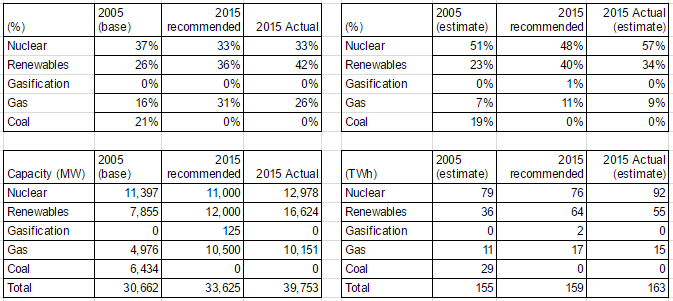
opa2005to2015actComp
Spreadsheet comparing OPA Supply Mix Advice from 2005 to estimated actual 2015 data.
1st posted in Reviewing a 2005 plan for Ontario’s electricity supply in 2015
19 days later, on September 18th 2008, a Minister of Energy and Infrastructure essentially killed 3 years of work with an unintelligible directive amending the 2006 Supply Mix directive.

Wednesday, March 30, 2016

Ontario's curtailed wind energy

Ontario's electricity system operator, the IESO, recently released multiple reports including a summary page for 2015's supply now inclusive of "dispatched down" data for industrial wind turbines (in the same format as their 2014 summary). This is the one instance during a year I can compare my estimated curtailment the IESO's reported curtailed wind supply. This year there are similarities, such as the wind curtailments significantly increasing, and there are differences, which I've used to adjust my methodology for estimating hourly curtailments.

The IESO data is not a comprehensive curtailment report. By "curtailment" I mean supply which is rejected by the IESO through any process. My definition includes Ontario Power Generation (OPG) hydro. OPG reports:
During each of 2015 and 2014, OPG lost 3.2 TWh of hydroelectric generation due to SBG [surplus baseload generation] conditions.
For both years, the OPG hydro losses double the amount of curtailment the IESO shows for the combination of "nuclear reductions" and "wind dispatched down."

Thursday, March 10, 2016

The cost of ending coal-fired generation, and renewables, in Ontario

Ontario stopped getting electricity from burning coal at the end of 2013. The coal exit is one element of Ontario's electricity system gathering attention from other jurisdictions, along with a very low greenhouse gas emissions intensity, the fastest growing (and possibly now the highest) rates in continental North America, and a high level of resistance to new generation from local residents. It might be logical for outsiders to associate the steep rise in the price of electricity as the cost of getting off coal, but that has not been the major factor pushing up rates.

Bruce Sharp, an energy analyst I greatly admire, recently produced Ontario Electricity - the Cost of Coal Replacement, which put some numbers up against an Ontario government document on The End of Coal. That document is not the proper starting point for evaluating the cost of ending coal, but Sharp's methodology for pricing provides a useful foundation to build an analysis upon.

table from Bruce Sharp's Ontario Electricity - the Cost of Coal Replacement

4,000 megawatts of wind, and 1,500 of solar, were not part of the plan to replace coal. I've previously demonstrated added natural gas and nuclear generators compensated for the removal of the coal-fired power plants.
Graphic from January 2013 post - data in this spreadsheet
Upon reflection, I think the proper starting point to evaluate the cost of exiting coal is June, 2005 - and it can include some wind. The elimination of coal was a 2002 recommendation of  an "all-party Select Committee on Alternative Fuel Sources", carried in the platforms of the three major parties into the 2003 election. That election was won by the party promising to eliminate coal by 2007 (not 2015 as the all party committee had recommended) - but they weren't succeeding in that goal, so in 2005 they released more specific plans described in this press release:

Friday, February 12, 2016

Eating wind: Carbon capped opportunity Part 2

Reading Rooftop coal: Carbon capped opportunity Part 1 will benefit readers of this post

There's a message being spread about Ontario that the expensive, but low carbon emission, electricity it produces will soon be worth big bucks due to the proposed Clean Power Plan in the United States - and trading of emissions. This was implied by one member of the Climate Action Group on television recently (I wrote on the program), and quickly expanded upon in into an article in The Toronto Star:
... the country’s power sector is prepping for a dramatic increase in U.S. demand for clean electricity.
Action on climate change is the reason — more specifically, U.S. President Barack Obama’s Clean Power Plan, which aims to slash carbon dioxide emissions from power plants by a third by 2030.
The plan is expected to triple the flow of Canadian electricity into Midwestern and northeastern border states, part of a broader U.S. effort to comply with the international climate obligations that 196 countries agreed to in Paris.
...
The North American Electric Reliability Corporation [NERC], which monitors and regulates grid stability in Canada and the U.S., estimated in a report last April that net Canadian electricity exports under the Clean Power Plan could grow three-fold between 2020 and 2030 as demand for renewable power grows in states such as Ohio, Michigan, New York and jurisdictions in New England.
Here we have the agreement from Paris and the U.S. Clean Power Plan discussed, so I'll briefly discuss each to communicate the value for Canada, and particularly Ontario, is limited - but an opportunity does exist.

The most relevant quote for the Paris deal comes from The New York Times' Coral Davenport back in August 2014:
...President Obama’s climate negotiators are devising what they call a “politically binding” deal that would “name and shame” countries into cutting their emissions.
...Countries would be legally required to enact domestic climate change policies — but would voluntarily pledge to specific levels of emissions cuts...
That "name and shame" strategy was advanced in Paris, primarily because the President lacked the ability to have Congress pass anything legally binding. Countries provide plans for reducing emissions, and if they don't achieve them they will be mocked by countries that are achieving their goals, should there be any.

The U.S. Clean Power Plan, if it gets enacted, will offer states a couple of methods to comply with individual emissions targets based on a subset of generators operating in the states in 2012 (I'd need to check in the volumes of text to confirm the base year) - the subset exclude generators without emissions in service prior to 2013 (most notably nuclear); it therefore basically includes almost exclusively emitting facilities.
States can target either emissions intensity, getting facilities to an average of ~20% below the intensity level of the 2012 base year (so replace coal with gas, of augment coal with wind, etc.), or they can just reduce their emissions by the requisite amount (it varies by state). Those sound the same, but the first option could actually see increased emissions. Illinois, for instance, could likely replace older nuclear units with natural gas generators and easily meet clean power plan targets by doing so.
Emissions reductions can come in state or not - by power purchase agreements with facilities outside of the state, or through the trading of cap space (such as through clean energy certificates).

How does this impact Ontario?
___

The North American Electric Reliability Corporation [NERC] reference in the Toronto Star article is probably Potential Reliability Impacts of EPA’s Proposed Clean Power Plan: Phase I, which does show a forecast where:
"Canada exports three times more power to the United States, mainly NPCC and MISO North."
NPCC is the Northeast Power Coordinating Council and it includes Canadian provinces/systems east of Manitoba as well as the New England and New York system operator areas (NYISO and ISONE).

The NPCC jurisdictions don't import much more juice in the NERC work:
graphically edited to most relevant data from NERC "Potential Reliability Impacts of EPA's Proposed Clean Power Plan
The "MW Interchanges No CPP" indicates, for Canada, net exports of 5,461 megawatts on average if the Clean Power Plan doesn't come into force, which works out to an annual total of about 48 terawatt-hours (TWh), and that is the average that actually occurred from 2012-2014. The best case (State level application of the Clean Power Plan) offers an export opportunity into New York and New England systems of another 691 megawatts on average, but that's little more than Ontario wasted in 2014 as generators reportedly curtailed an average of ~550 megawatts (by way of annual totals of 376 thousand MWh of wind, 1.2157 million MWh of nuclear and 3.2 million MWh of hydro-electric power). The NERC document that enthused Tyler Hamilton writing in the Star doesn't offer much hope for the U.S. northeast bailing Ontario out of its over-supply.