When the Ontario Power Authority (OPA) released data projections made in supporting the development of Ontario's latest Long Term Energy Plan (LTEP) they showed the cost of purchasing generation from solar would grow about $280 million in 2014 (in 2012 dollars), and $443 million in 2015. The OPA anticipated that 45% of the growth in in generation costs from 2013 through 2015 would be due to the costs of purchasing production from solar panels.
45%
45% of the cost increase over a 2 year period puts solar, in 2015, as about 1% of supply but 10% of total supply cost (according to the OPA work for the LTEP).
I've spent some time trying to incorporate hourly estimates of solar input into my tracking of Ontario electricity data. It's not easy, and it's dynamic, so I'm writing this post to explain how I'm estimating solar production, why my estimates change, why they are better than anything else most, if not all, will see - and what the estimates show.

Cold Air: Analysis and commentary on energy, environment, and politics
Monday, July 21, 2014


Tuesday, June 24, 2014
wasted on the traditional territory of the Mississaugas
"Ahnee, Bon Soir, Bojoo.
We’re gathering on the traditional territory of the Mississaugas of the New Credit."
So begins speeches in Toronto by Toronto's Premier, Kathleen Wynne. [1]
___
In March, 2013, Ontario Power Generation (OPG) announced, "Ontario’s new Niagara Tunnel is producing more clean, renewable, low-cost electricity at the Sir Adam Beck generating complex." The project had seen delays and early budget overruns which pushed the project cost up to $1.5 billion. The payoff for the work was to be "about 1.6 billion kilowatt-hours."
.png)
OPG announced the project complete and in service in March 2013. The growth in annual (12-month) production was ~600million kilowatt-hours, or 0.6 terawatt-hours (TWh). While this is less than 40% of the promised 1.6TWh, it is still presents far too favourable a picture of what happened after the tunnel entered service.
Monday, June 23, 2014
Ontario's electricity future isn't this Quebec Diversion
Importing electricity from Quebec is in the mainstream media again.
There are reasons the option appears attractive. Quebec has an abundant supply of hydroelectric power, so there is the appearance of an opportunity. Additionally, the demand profiles of Quebec and Ontario could be considered complimentary: Quebec has a winter peak, and Ontario has had, in recent years, a summer peak.
The peaks aren't as complimentary as they sound. Ontario acually has a winter energy consumption peak too. The peak use of electricity is usually in the summer as the province heats mainly with natural gas in the winter. That is not the case in Quebec, where the winter energy peak is an electricity peak.
Ontario has only had local calls for conservation over the past couple of years (Toronto area), but Hydro Quebec called for conservation during winter demand peaks in both 2013 and 2014.
Ontario's first (and only public) Integrated Power System Plan (IPSP), released in 2007, noted an additional 1250MW of "Quebec Interconnection" as part of supply intended to meet the desired "Renewable Resources Goal." That interconnection has since entered service. I have been tracking hourly intertie data back to April 2011; connecting that data with Ontario's top 25 winter, and summer, demand peaks shows that the flow of electricity between the provinces is exactly as logic dictates it should be.
There are reasons the option appears attractive. Quebec has an abundant supply of hydroelectric power, so there is the appearance of an opportunity. Additionally, the demand profiles of Quebec and Ontario could be considered complimentary: Quebec has a winter peak, and Ontario has had, in recent years, a summer peak.
.png) |
| Quebec figures from HQ document (Dec. estimated) |
Ontario has only had local calls for conservation over the past couple of years (Toronto area), but Hydro Quebec called for conservation during winter demand peaks in both 2013 and 2014.
Ontario's first (and only public) Integrated Power System Plan (IPSP), released in 2007, noted an additional 1250MW of "Quebec Interconnection" as part of supply intended to meet the desired "Renewable Resources Goal." That interconnection has since entered service. I have been tracking hourly intertie data back to April 2011; connecting that data with Ontario's top 25 winter, and summer, demand peaks shows that the flow of electricity between the provinces is exactly as logic dictates it should be.
Wednesday, June 11, 2014
Ontario's next expense scandal: Endorsement and Condemnation
Tomorrow, Ontario votes to elect its next government.
It's been an interesting campaign for me, particularly because of some thoughts on the province's electoral politics I worked through writing on the last election, in 2011, and an ongoing interest in the relationship of numbers and narratives.
My perception of provincial election campaigns are shaped by statistics on the share of possible votes (registered voters) achieved by parties. After 2011's election I began Lessons From Ontario's Record Low Election Turnout with:
My premise has been that Ontario elections have been more about attracting voters, not moving the votes of voters from one candidate to another. This hasn't been true at the federal level, where the split in the Conservative movement returned successive majorities to the Liberal party, and it's not entirely true provincially, but the provincial conservatives should be able to win an election only by getting most of the people who vote Conservative federally to show up and do so provincially.
It's been an interesting campaign for me, particularly because of some thoughts on the province's electoral politics I worked through writing on the last election, in 2011, and an ongoing interest in the relationship of numbers and narratives.
 |
| election results - as share of possible votes |
One of Ontario’s 3 main political parties had a lower percentage of eligible voters opt for their party than had been the case since 1943.
That party won.
My premise has been that Ontario elections have been more about attracting voters, not moving the votes of voters from one candidate to another. This hasn't been true at the federal level, where the split in the Conservative movement returned successive majorities to the Liberal party, and it's not entirely true provincially, but the provincial conservatives should be able to win an election only by getting most of the people who vote Conservative federally to show up and do so provincially.
Friday, May 23, 2014
Not Honouring Ontarians: Wynne's Green Energy Contracts
I sent some numbers to Parker Gallant the other day, along with a question on political donations, and within days the prolific Mr. Gallant produced, "Constraining wind power in Ontario: Making your head spin..."
Before I introduce the figures behind that column, I'll provide some background on the Ontario Liberal party's approach to contracts.
Another election campaign in Ontario is underway, and some of it is a repeat of the previous election campaign; the Progressive Conservatives (PC) claiming they can better control costs and the incumbent Liberals claiming the PCs will renege on contracts. Contracts bind participants to obligations: the Liberal government has failed to protect the people's side of green energy contracts a couple of times since 2011's election - where there is a benefit to their party to do so.
First, there was the Korean Consortium (KC, aka Samsung). In April 2013 I wrote on how they weren't meeting contract requirements, or investing significant amounts of their own funds. The KC deal, which PC leader Tim Hudak had stated, in 2011, he would kill, was re-written 2 months after I pointed out the Koreans weren't honouring the contract, but not killed.
The government claimed savings of $3.7 billion - money that they'd campaigned on not being possible to save in 2011. Worse, the contract renegotiated - because the proponent had not kept it's initial contract commitments - guaranteed the KC a base price of 29.5 cents per kWh for the still contracted solar capacity; that's a price far exceeding what it would cost for, as one example, the public generator to provide grid-scale solar capacity.
So it looks like I saved Ontario $3.7 billion, but I could have saved far more if the Liberals had the decency to cancel a contract because contract obligations were not fulfilled by the proponent - instead of providing expensive plums to the negligent proponents in order to avoid having Tim Hudak be shown to be correct.
Tuesday, May 13, 2014
Hudak's numbers and the MSM's biased suspicion
I understand fact-checking political statements but let's be fair...
I'd read Maclean's "Infographic: Where the jobs are in Ontario", and was struck by a couple of things in the opening paragraph:
I'd read Maclean's "Infographic: Where the jobs are in Ontario", and was struck by a couple of things in the opening paragraph:
Ontario PC leader Tim Hudak is staking his electoral changes [chances] on a promise to create one million new jobs if elected, even while cutting 100,000 public sector positions. That may be a challenge since the provincial economy has created just 667,000 new jobs since the Liberals came into power in 2003. Nearly half of those jobs have been in the public sector.Two things:
- what is Hudak staking his electoral chances on?
- what message might the press be broadcasting?
Friday, May 9, 2014
Ontario's electricity supply outlook is the worst in North America
Early last December Ontario’s Liberal government released their latest “Long-Term Energy Plan” (LTEP). The document indicated Ontario currently has sufficient capacity to meet “North American reliability standards,” unlike a decade earlier when the Liberals came to power in Ontario.
North American reliability standards are the domain of the North American Electric Reliability Corporation (NERC). Within a week of the release on the LTEP in Ontario,NERC released its 2013 Long-Term Reliability Assessment, which noted, “In the summer season of 2018, the NPCC-Ontario Anticipated Margin falls below the NERC Reference Margin Level.”
4 years is a very short time for developing reliable supply.
Ontario supply was tight in 2003, but work was underway for more; ~1250MW of capacity returned to service by the end of 2003, ~1400MW in 2004, and another 500MW in 2005. [1]
The firm supply Ontario added from 2003-2005 is different than the capacity additions planned for the next few years, which is primarily from variable intermittent energy sources (vRES); wind and solar.
In 2004, Ontario’s supply outlook was not sufficient to meet North American reliability standards. Today’s margins are above required levels. This reflects the strong supply of electricity the province is enjoying. Ontario has gone from a deficit of 3,800 MW in 2003 to a comfortable surplus in 2013.
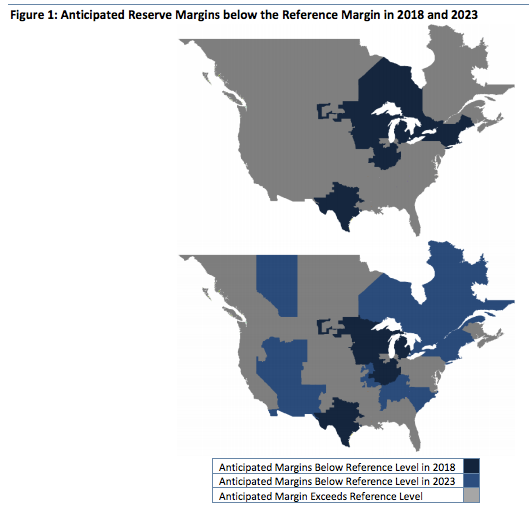 |
| NERC 2013 Long-Term Reliability Assessment, page 5 |
4 years is a very short time for developing reliable supply.
Ontario supply was tight in 2003, but work was underway for more; ~1250MW of capacity returned to service by the end of 2003, ~1400MW in 2004, and another 500MW in 2005. [1]
The firm supply Ontario added from 2003-2005 is different than the capacity additions planned for the next few years, which is primarily from variable intermittent energy sources (vRES); wind and solar.
Wednesday, May 7, 2014
Zombie docs living in Ontario's zombie budget
The Ontario government delivered its budget on May 1st; the NDP announced they would not be supporting the government any longer on May 2nd, and the Premier threw in the towel putting Ontario into an election campaign.
The budget may never have been intended to be practical, but created solely to be a "zombie" document to reference during a campaign.
I was surprised to see the budget repeated a graphic based on the same Hydro-Quebec (HQ) report I debunked in picking apart Environmental Defence's lousy report on Ontario Energy Costs.
The HQ report graphs values of 12.475 cents/kilowatt hour (kWh) on a 1000kWh bill) for Toronto [1] and 12.391 cents/kWh for Ottawa.
I don't mean to criticize the HQ report, although those are the two figures I know best in it and they are wrong.
I do mean to criticize the former Ontario government that cynically included numbers from HQ in an Ontario budget. While I'm at it, I'll criticize their base too - apparently the urban voters favouring the Liberal party can't figure out what they pay for electricity, and that it is not what their government tells them Quebec's public electricity company reports they are paying.
The budget may never have been intended to be practical, but created solely to be a "zombie" document to reference during a campaign.
 |
| bad data illustration from page 134 of the 2014 Ontario Budget |
I was surprised to see the budget repeated a graphic based on the same Hydro-Quebec (HQ) report I debunked in picking apart Environmental Defence's lousy report on Ontario Energy Costs.
The HQ report graphs values of 12.475 cents/kilowatt hour (kWh) on a 1000kWh bill) for Toronto [1] and 12.391 cents/kWh for Ottawa.
I don't mean to criticize the HQ report, although those are the two figures I know best in it and they are wrong.
I do mean to criticize the former Ontario government that cynically included numbers from HQ in an Ontario budget. While I'm at it, I'll criticize their base too - apparently the urban voters favouring the Liberal party can't figure out what they pay for electricity, and that it is not what their government tells them Quebec's public electricity company reports they are paying.
Subscribe to:
Posts (Atom)